Home Knife Collecting

Knife Collecting

Knife collecting is an extremely rewarding experience for knife enthusiasts. There truly is a knife for everyone. Many increase or hold their value throughout the years, making collecting knives something to pass on to the next generation of knife collectors.

Knife Mechanisms: Gimmicks Or Game Changers?

0

Folder features evolve at a fast clip.

Today’s knife market is a dynamic mix of time-tested traditions, evolving design applications and cutting-edge innovations. Designs are as varied as the people who carry them, and what someone chooses as an everyday carry (EDC) knife can be a cultural marker as much as a cutting tool. One of the key features of EDC knives is their mechanical operation. In this article, we will explore the fascinating realm of folding knives, examining the influence of knife mechanisms on consumer preference, the evolution of some of the most iconic designs and whether today’s emerging ideas are gimmicks or game changers.

Old Is New Again

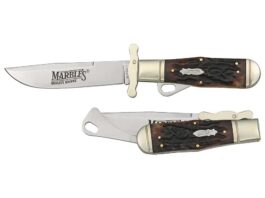
The folding knife industry is often associated with mechanical innovation. However, according to industry experts, there is a notable trend regarding classic slip-joint knives. The traditional non-locking folder, often affectionately called a pocketknife, is experiencing a demand revival.
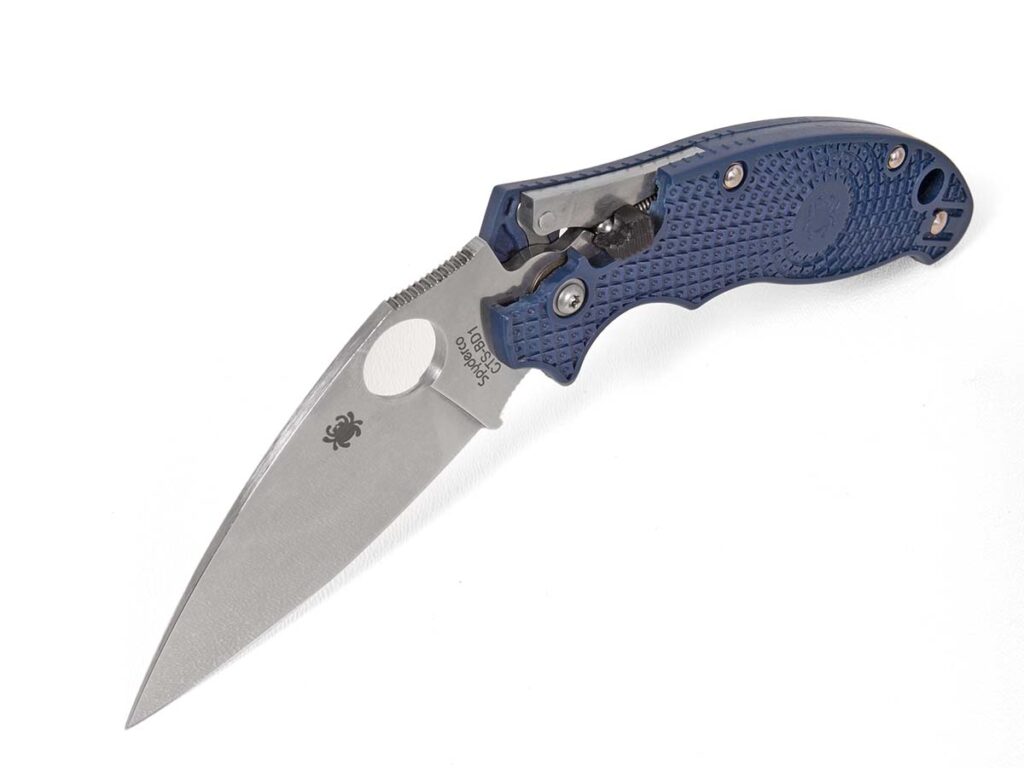
 As its name suggests, the Spyderco Manix 2 Lightweight features ultra-lightweight construction and the Ball Bearing Lock mechanism, which can be seen in this custom cutaway version. The knife’s overall length is 8 inches, with a 3.37-inch blade offered in multiple steel options, depending on the specific model.
As its name suggests, the Spyderco Manix 2 Lightweight features ultra-lightweight construction and the Ball Bearing Lock mechanism, which can be seen in this custom cutaway version. The knife’s overall length is 8 inches, with a 3.37-inch blade offered in multiple steel options, depending on the specific model.

“I’d go out on a limb and say that slip-joint knives are having a moment right now,” said Doug Flagg, former vice president of marketing and innovation at Columbia River Knife & Tool (CRKT). “Innovation will never go out of style, but in a lot of ways, what’s old is new again.” Flagg added that CRKT recognized this slip-joint revival and has already developed recent models to answer consumer demand, including the Symmetry and Venandi models, designed by Richard Rogers, and the Darriel Caston-designed, double-bladed Forebear.

Regarding specializing in traditional folders, W.R. Case & Sons is arguably second to none. On the topic of slip joints, Tony DiFonzo, director of engineering at Case Knives, acknowledged that many people prefer the look and feel of tried-and-true knife designs, like Case’s Sod Buster, Trapper and Stockman. He added that their less-intricate designs imply greater reliability.

“Sometimes, it’s better to simplify and have something that you know is going to work repeatedly,” DiFonzo said. “The influence of debris and the wear and tear of repeated real-world use can cause a knife with complex components to not fire or lock up like it should. We don’t want it to look cool on a shelf; we want it in people’s pockets to use every day.”
According to DiFonzo, Case continues to meet their customers’ demand for traditional knives by producing about 6,000 slip-joint knives daily, contrasting them with their locking knife line, which accounts for only about 20 percent of Case’s overall consumer line.

Mechanical Evolution
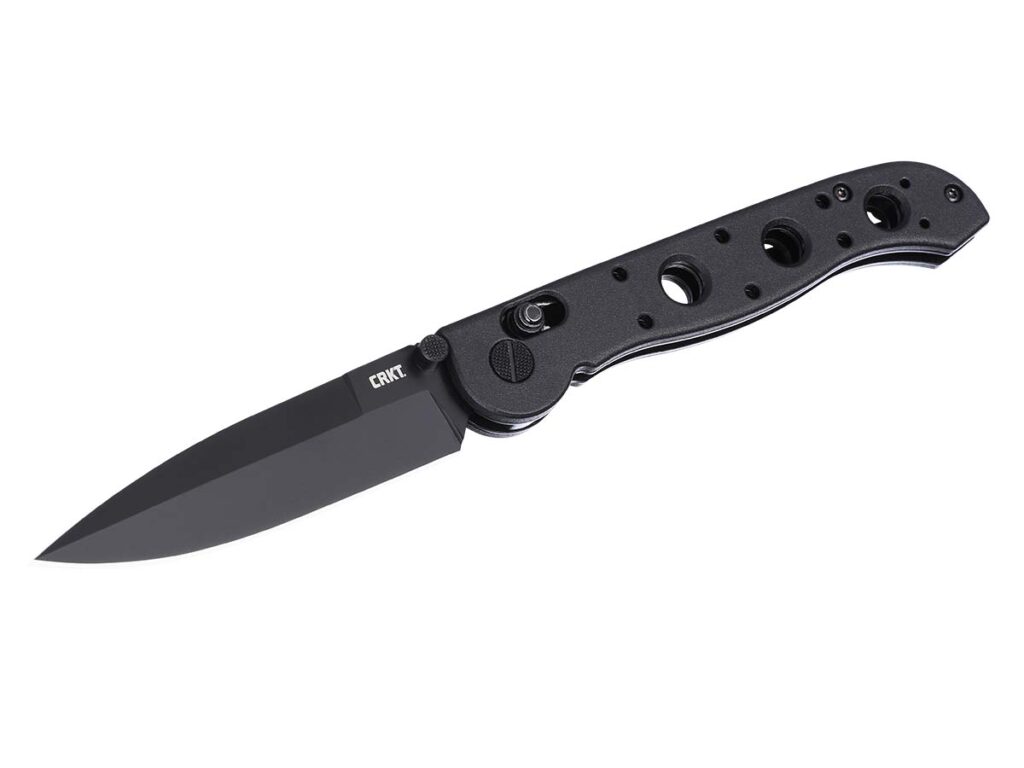
Part of the CRKT M16 series designed by Kit Carson, the M16-03XK features an ambidextrous Crossbar Lock paired with an IKBS (Ikoma Korth Bearing System) ball bearing pivot for seamless deployment and easy one-hand closing. It also has a lightweight Grivory aircraft-grade thermoplastic handle.

These days, many of the mechanisms we take for granted were once novel inventions conceived by imaginative innovators. For example, an assisted-opening knife didn’t exist before Blackie Collins bringing his design to market, famously inspired by the single-strut suspension on his Ducati motorcycle. Before Michael Walker’s revolutionary LinerLock design, closing a locked folding knife was virtually always a two-handed job. In subsequent years, variations and often improvements of both innovations began to proliferate in the industry and become all but ubiquitous. These are only two examples of numerous similar evolutions.

Time makes it easy for innovators who changed the industry to be forgotten after expired patents, as their inventions become “democratized,” as Michael Janich, special projects coordinator at Spyderco, characterized it. He drew careful attention to the importance of these noteworthy creation stories: “It’s counterproductive when it comes to promoting industry education and a sense of history,” Janich said. “People new to knives don’t understand the origin of the mechanism or appreciate its history.”

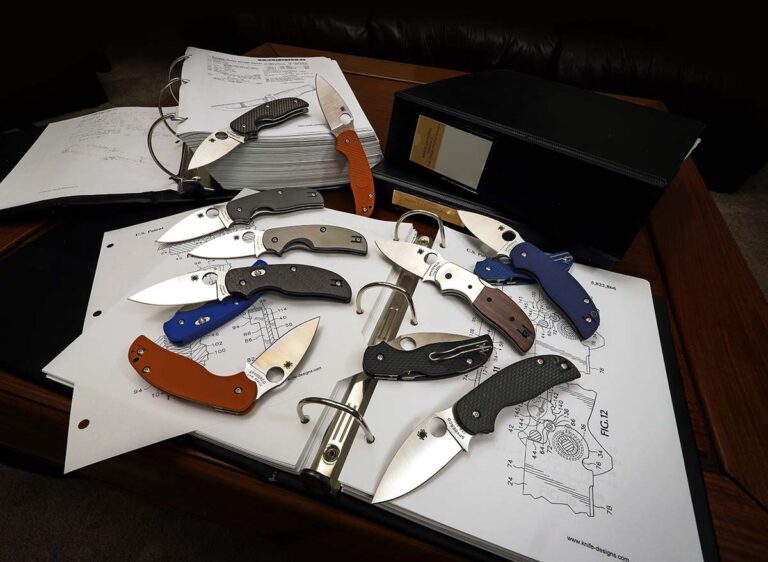
In 2008, Spyderco created the ongoing Sage Series to draw a historical line between pioneering locking mechanisms and the makers who created or popularized them to assign credit where credit is due. To accomplish this, each Sage Series model features a different key advancement. The Sage 1 incorporates two Michael Walker mechanisms: the LinerLock and the ball bearing detent. The Sage 2 features Chris Reeve’s RIL (Reeve Integral Lock), a.k.a. the frame lock. Sage 3 features Blackie Collins’ Bolt Action Lock, improved by Spyderco with easy-to-operate ambidextrous release buttons. Sage 4 pays tribute to Al Mar by integrating a mid-back lock, a signature element of Al Mar Knives. Completing the series, thus far, the Sage 5 and Sage 5 Lightweight models feature the Compression Lock designed by Spyderco Founder Sal Glesser.
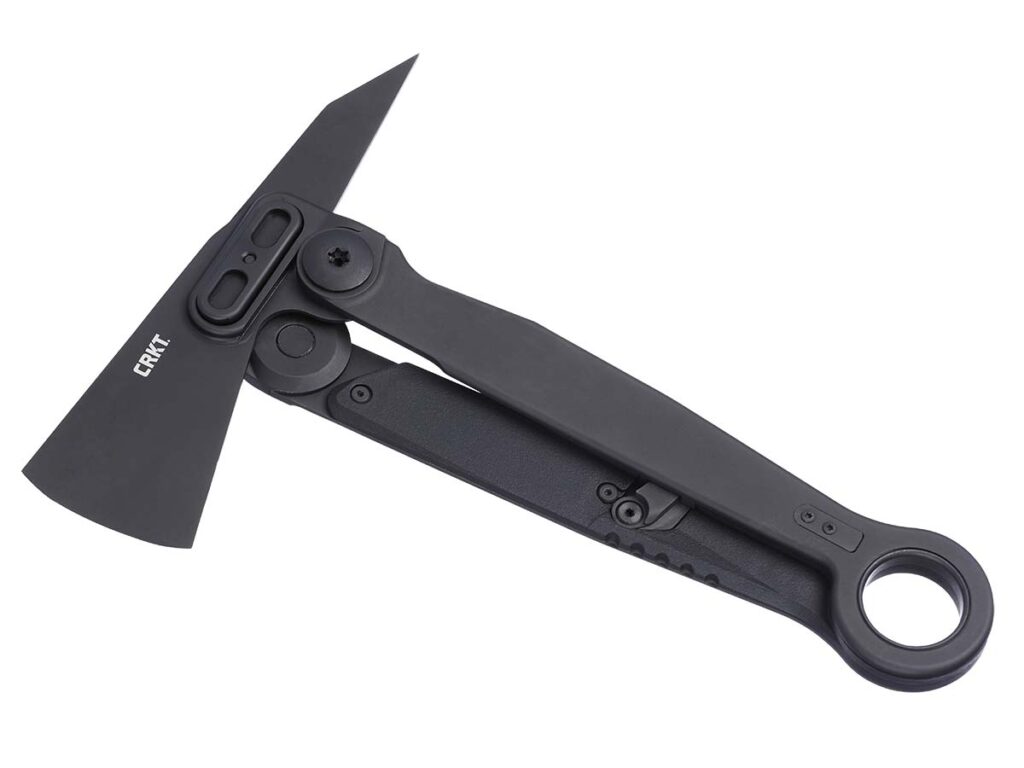
The CRKT Provoke X morphing axe incorporates the company’s Kinematic deployment mechanism from its successful Provoke folder into a new product category. This first-of-its-kind axe combines the excitement of Kinematic deployment with the security of the Deadbolt Lock.

Many folders included in Spyderco’s current line-up feature the company’s proprietary locks, such as the Para 3, a compact version of the popular Paramilitary 2 folder, featuring Glesser’s Compression Lock, and the Manix 2 Lightweight, featuring a Ball Bearing Lock invented by Sal’s son, Eric. Both locking mechanism patents have now expired.

Historical context intact or not, widespread adoption and adaptation of mechanisms due to patent expiration play a significant role in today’s popular trends. Like any other patent, a knife mechanism patent expires after 20 years, after which the design enters the public domain. Then, anyone can legally manufacture and sell products incorporating that mechanism without requiring permission from the original patent holder. Along with Spyderco’s recent expirations, the Benchmade Axis Lock patent also recently expired, which has been felt across the industry.

Versions Of Their Own

“You’ll note an uptick in knives featuring what was originally called the Axis Lock, now commonly referred to as the Crossbar Lock,” Flagg said. “Now that it’s available to the industry at large, many manufacturers, including CRKT, are coming to market with versions of their own.”
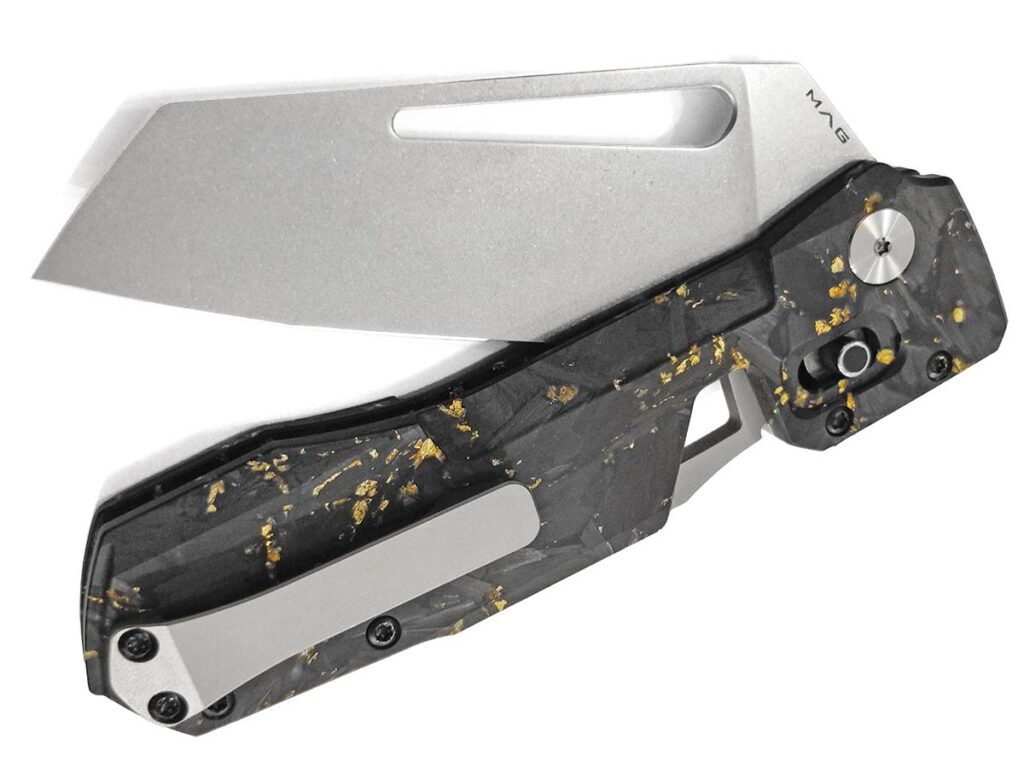
Winterblade’s Factor 8ight features an all-new “QUAD Magnet Detent System,” the company’s strongest and most adjustable magnetic detent system to date, as well as an updated “M-Lock Plus” magnet-driven blade lock, and improved titanium flip-lever deployment mechanism for snappy action.

CRKT began using the Crossbar Lock in 2024 and is now carrying it forward into the iconic Kit Carson-designed M16 collection. “It’s got a fluidity and ease of use that consumers seem to gravitate toward, and I think you’ll see more knives using the technology coming out each year,” Flagg said.

Indeed, many other knife companies produce similar bar-style locks, often under different names, including Hogue’s ABLE Lock, SOG’s XR Lock and Civivi’s Superlock. Patent expiration also levels the playing field for smaller manufacturers by allowing them to use popular mechanisms without the cost or hassle of licensing, which is a game-changer.

Janich says that many of the hot new locks are subtle mechanical variations of the original Blackie Collins Bolt Action Lock from the 1970s, which, he added, never received the recognition it deserved. “The Bolt Action Lock was, to my knowledge, the first to be based on the mechanics of creating a ramp on the back of the blade and wedging a locking device between that ramp and the stop pin or backspacer.”
As an in-line mechanism, he says, the wedge concept became the basis for the Axis Lock, Ball Bearing Lock, Arc Lock and Stop Lock, among others, and it continues to be the basis for many of today’s most popular locks, including the Shark Lock, Atlas Lock and Superlock. “The in-house production secret is making the mechanics just different enough to convince the USPTO [United States Patent and Trademark Office] that it’s unique.”
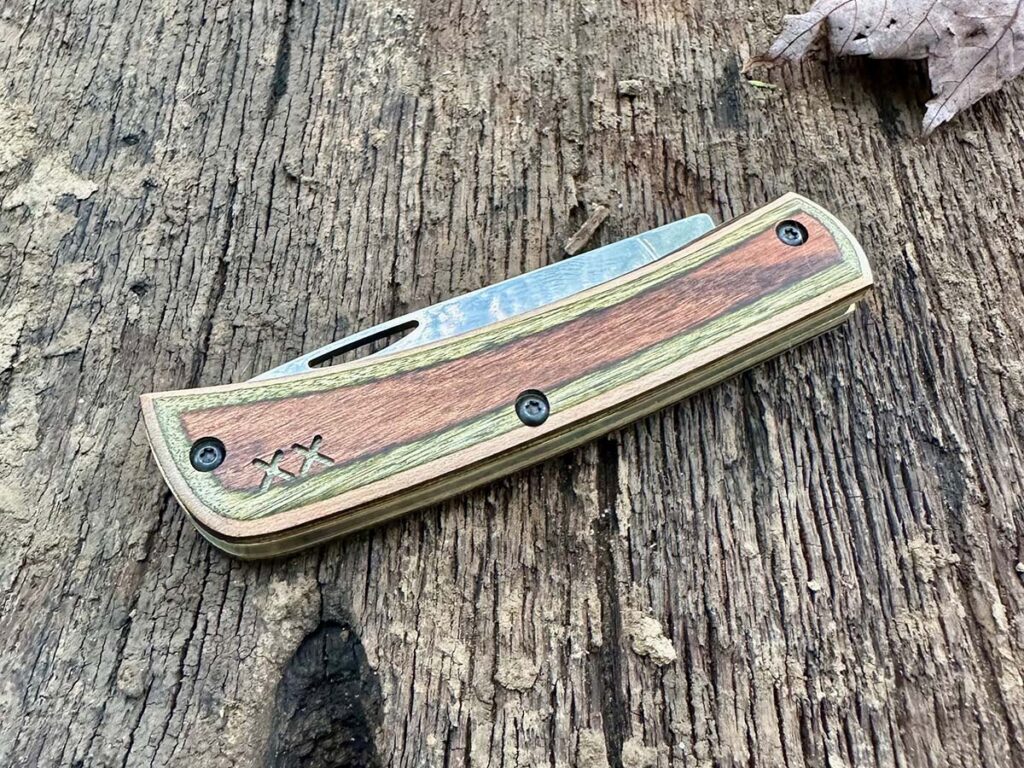
The Classic American Case Sodbuster Jr. is a testament to U.S. craftsmanship and durability. It embodies reliability, functionality, and traditional style all in a compact design. The Sod Buster Jr. in this photo has a 2.875-inch stonewashed skinner blade and a Smooth Black Canvas Laminate handle with Day Glow G10 liners.

Janich said he doesn’t foresee any locks disappearing completely as new ones join the market. He mentioned that the classic back lock mechanism is still the bread and butter of many Spyderco designs. Though he acknowledges it’s an old-school design, he attributes its continued popularity to seasoned knife users who, he said, tend to have strong preferences, especially when lock failure could result in bloodshed.

Gimmicks Or Game Changers?

On one side of the demographics spectrum are seasoned knife users who field dress game and integrate EDC knives into their self-defense strategies. On the other side is the next generation of knife customers, whose industry knowledge mainly comes from YouTube influencers posting POV (point of view) knife reviews. The latter customer base is often mainly drawn to what is widely regarded as the “fidget factor,” where interest and excitement are focused primarily on knives with intriguing opening, closing and locking mechanisms. Smooth, snappy action is in demand, and the more intricate, the better.

“There are lots of younger knife users who have never had to use a knife hard,” Janich said. “In many cases, they like fidget-friendly designs that open and close easily and are entertaining.”
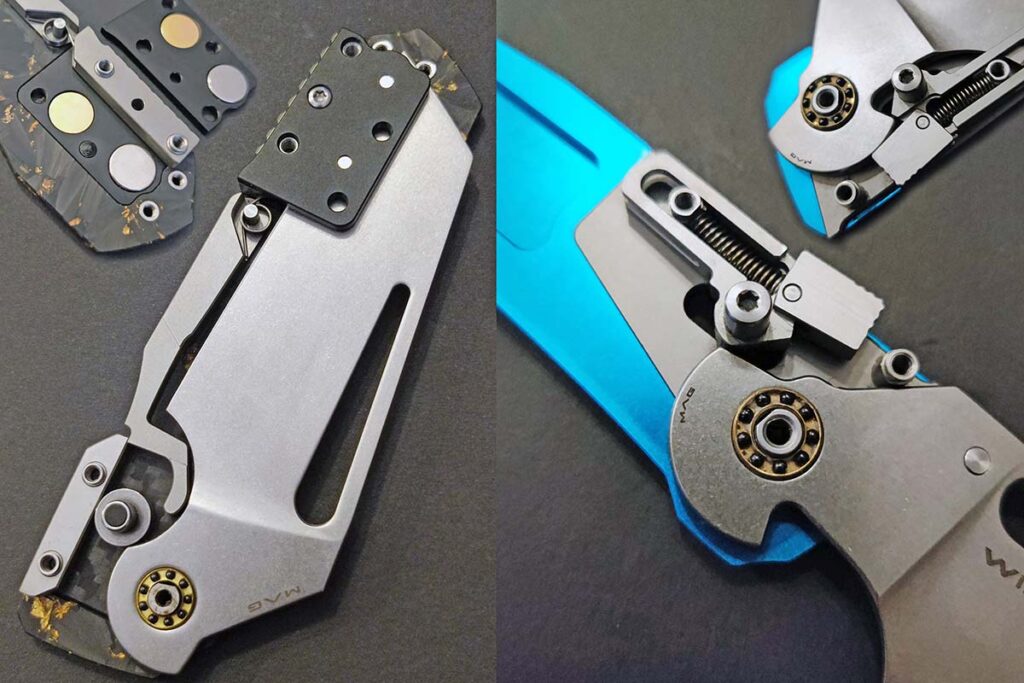
The Severn features Winterblade’s patent-pending compression spring, Stealth Lock, and Dual Lock actuation, which includes a bar lock and a retracting spine lock in one mechanism.

Bryan Winters, owner of Winterblade Knives and a relative newcomer to the knife industry, doesn’t have concerns about “fidget factor” characterizations, despite his knives being on the cutting edge of fidget-ry. He captures his philosophy by saying, “We can’t spell function without fun.” Winters started making his earliest creations in his modest shop in 2019, but 2022 was the year he launched his flagship design, the Factor, a stout, legitimately dependable folder, featuring cutting-edge new mechanisms that integrate magnets into the locking and deployment systems.

“I’ve never set out to design a knife just because I think it will sell well or because it’s a certain gimmick,” Winters said. “I’ll use magnets, but if I think springs are better suited for that particular mechanism, I’ll use springs, or maybe I’ll need some sort of lever or gears, whatever the case may be.”

He explained that, in the Factor, and later incarnations like the Factor 8ight, the detent magnets “suck the blade in” and keep it securely closed. An added benefit is alleviating the contact point of friction with a typical detent ball, allowing for noticeably smoother deployment. A benefit of the neodymium magnets is that they retain their power for almost a century, whereas springs fatigue or wear out much more quickly through continued use.

“My point with the people who say that magnets are gimmicks is, you can do things with magnets, physically speaking, that you cannot do with springs.”

Radical Reimagination

Another novel Winters creation is his radical reimagination of a double-action firing mechanism on the Darkfire OTF. Instead of a typical fixed slider, the blade is propelled in and out via a large blade guard that acts as a lever. The stylized blade guard is part of an overall design aesthetic inspired by the Mandalorian Darksaber from “Star Wars.” Inside, the brilliantly reimagined, simplified mechanism is powered by a single compression spring, again departing from traditional designs.

Whether one prefers the simplicity of a traditional slip joint, the fidget-friendly nature of modern deployment and locking systems, or the cutting-edge ingenuity of truly novel mechanisms, one requirement for success is that function meets the real-world needs of end users. Examples that Flagg pointed out in the current CRKT line are Flavio Ikoma’s proprietary Deadbolt Lock design, featured on several of the company’s knives since its creation five years ago, and Joe Caswell’s Kinematic opening system, which Flagg characterized as “a true innovation marker.” The Kinematic mechanism has several pivot points and linkage arms that “morph” into the opened knife when manually actuated.

“Joe is a bit of a mad scientist, in the best sense of that term, and his Provoke knife, with its Kinematic opening technology, was an instant bestseller for us,” Flagg says of its 2019 release. “Now, we’ve taken it to the next level and brought this innovation into our Provoke X, a morphing tactical axe that combines Kinematic opening with the Deadbolt Lock to create an EDC axe unlike anything the industry has seen before.”

The knife industry has a long legacy of benefiting from an enduring heritage while enabling innovators to push boundaries. It engages a wide variety of collectors and enthusiasts by offering as many knife designs as there are preferences and needs, whether nostalgic, futuristic or anywhere in between. Today’s trends show no indication of that dynamic subsiding in the foreseeable future. As such, all indicators point to an industry that will remain both reassuring and exciting.

More Reviews:

Legendary knives that gave the U.S. military its edge

These knives formed the tip of the U.S. Military’s spear.

The 20th and 21st centuries saw some of the most iconic of military knives. From the World War I trench knives with the imposing knuckle-duster D-guards to today’s modern folders and fixed blades, a few, in no particular order, stand out above the rest:

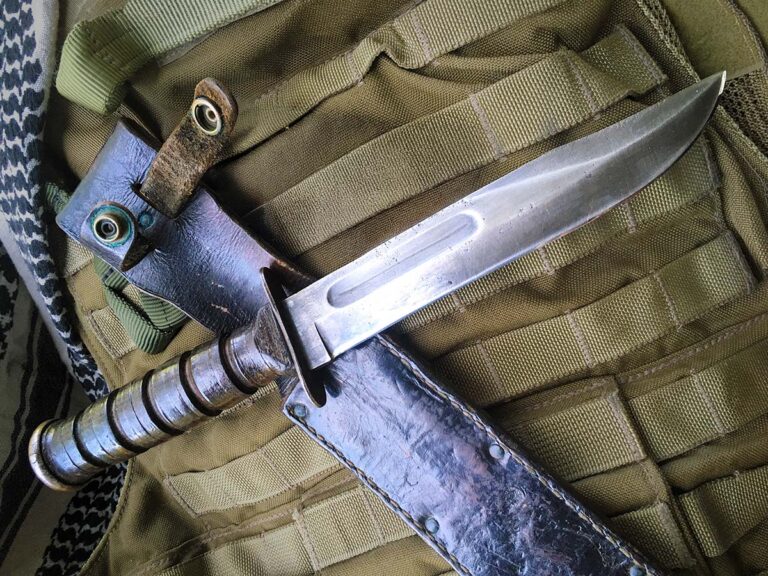
  • USN Mark II/USMC fighting-utility knife*: According to Army Special Forces veteran and Spartan Blades co-owner Curtis Iovito, “The KA-BAR fighting/utility knife is arguably the most recognizable American military knife ever produced. Introduced in 1942 for the U.S. Marine Corps during World War II, it solved a critical problem: troops needed a knife that could serve both as a weapon and a field utility tool.
    “Marines used it for everything from opening ammunition crates and cutting brush to close-quarters combat. Its design struck a near-perfect balance between fighting knife and utility blade, and it has influenced military knife design ever since.”
    “As an issue knife, the classic USN Mark II filled the same role as the Randall Model 1, but in a much more ‘democratized’ sense. Very few soldiers could get a Randall,” explained Army veteran and Spyderco Special Projects Coordinator Michael Janich, “but the Mark II/Ka-Bar was ubiquitous. Although it ultimately became best known as the Ka-Bar and most closely associated with the Marine Corps, it was manufactured by many other companies and widely issued. As a mass-produced item, it was—and still is—a very capable knife and continued to serve with distinction in many other wars after World War II.”
    “The USMC fighting knife has not always been made by KA-BAR, and KA-BAR didn’t even make them first, but they made it their own,” noted Marine Corps veteran/knifemaker Les George. “It’s the stereotypical military knife in the western hemisphere.” Added Army 5th Special Forces veteran/BLADE field editor/knifemaker Kim Breed, “It is a multi-use combat knife used in one form or fashion in all branches of the service.”
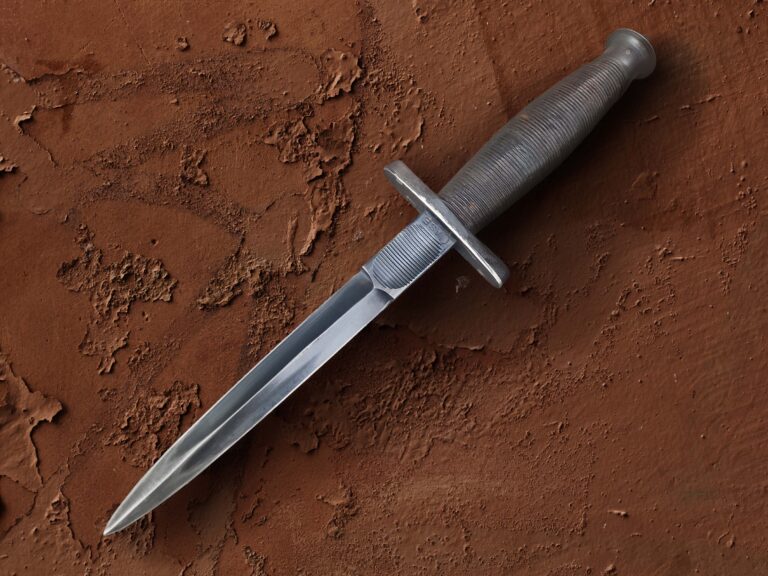
  • V-42: As Janich noted, “The V-42 is not only one of the sexiest fighting knife designs ever created, it also has perhaps the strongest pedigree since it was designed for and by the First Special Service Force, aka The Devil’s Brigade, of World War II fame. Its unique design and signature sheath reflect the original mission of that unit, which is regarded as the predecessor of current U.S. Army Special Forces units and Canada’s Joint Task Force 2. This iconic design is also immortalized in many U.S. military unit insignia, though it is often mistaken for the Fairbairn-Sykes dagger.”
  • Randall Model 1: “Randall has done more to influence modern knife design language than most,” George wrote. “The Model 1 is what I think of as peak Randall. Its influence ranges from World War II to the unit-made SOG knives in Vietnam to the modern SOG knife company.”
    “This iconic design epitomizes everything a military-style fighting knife should be,” Janich opined. “Its blade captures the spirit of the classic bowie knife, but in a leaner, more maneuverable form. The sharpened false edge allows it to back cut and penetrate with extreme authority, and its handle design allows for a grip that is both deft and secure. The fact that it continues to serve downrange in the same basic form to this day is a testament to the fact that it started out damned near perfect.”
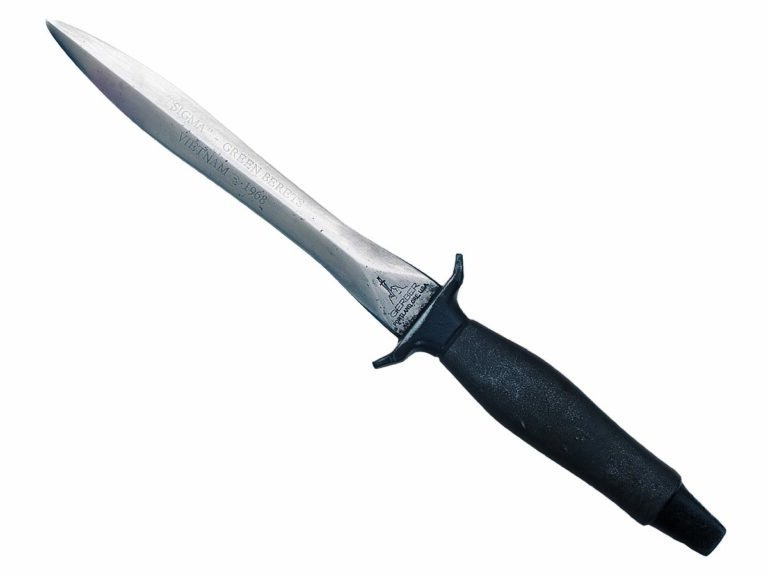
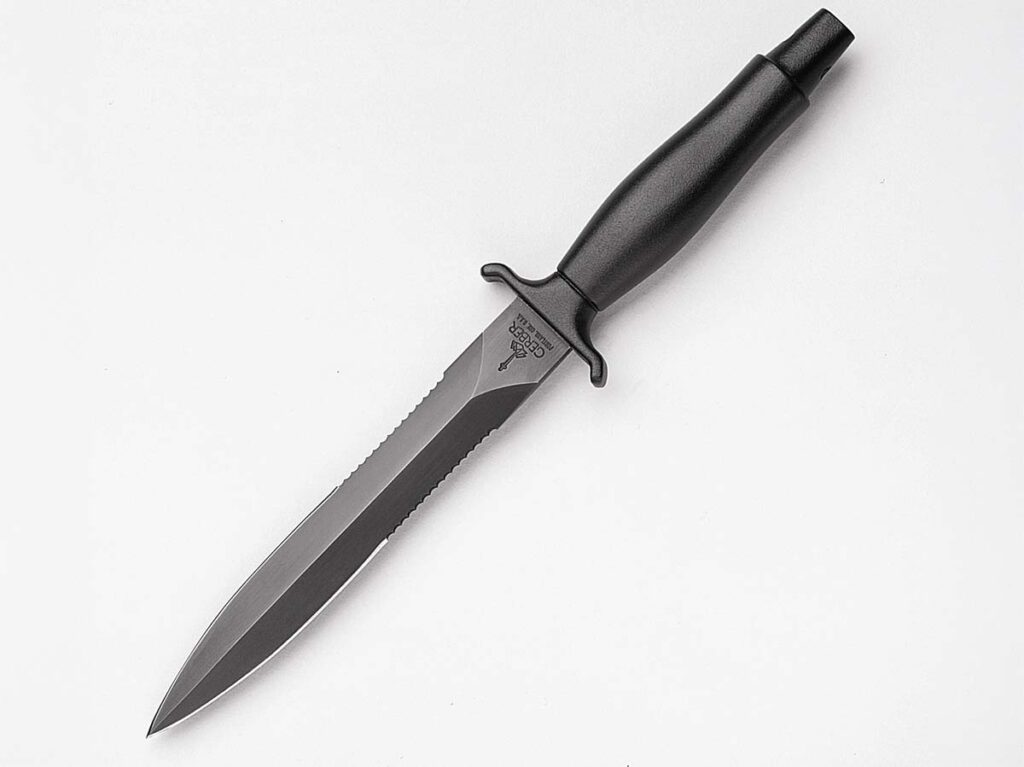
  • Gerber Mark II: “The shortcomings of the original Fairbairn-Sykes and the many variations it inspired became very well-known both during and after World War II,” Janich wrote. “The Gerber Mark II addressed and corrected all of these to offer a superior fighting dagger design. Although it was a private-purchase item, like Randalls, it was much more accessible to servicemen and more widely carried. Its unique variations and its evolution over time also created its own rich history.” Janich added the fact it was the favored combat knife of Michael D. Echanis, decorated Vietnam veteran, accomplished martial artist and hand-to-hand combat knife writer and editor, enhanced its mystique and widespread appeal as well.

More Standouts

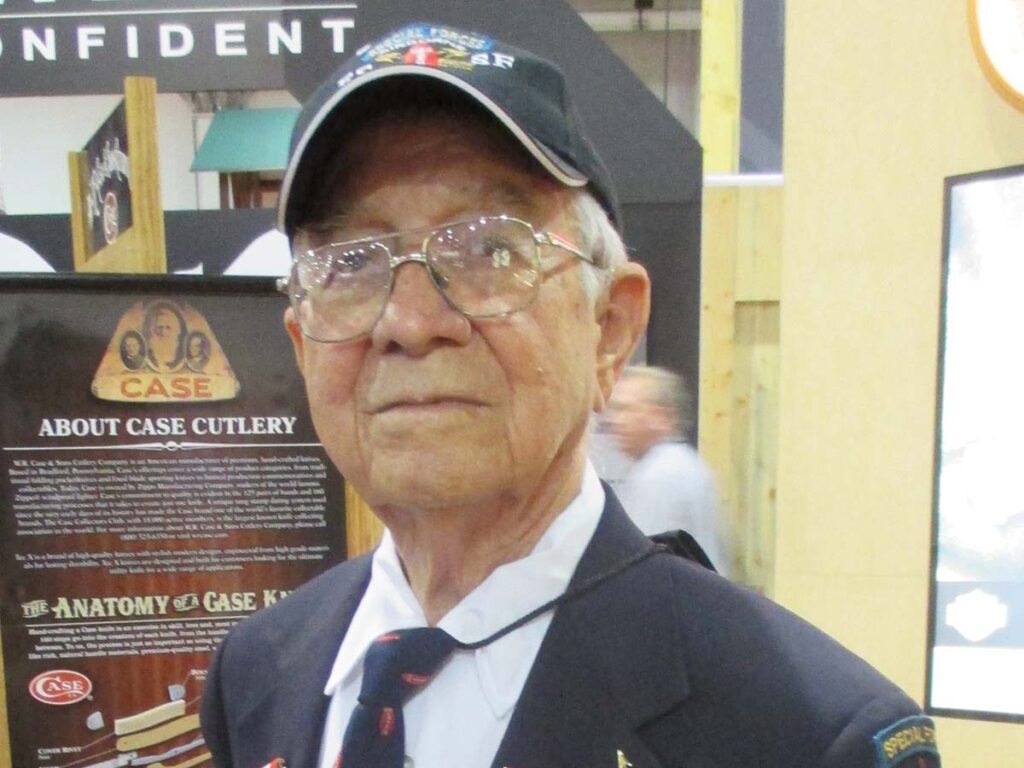
Gene Gutierrez
Gene Gutierrez

Any number of other U.S. military knives have stood out since the turn of the 20th century. Among them are the M3 trench knife, M1 bayonet, the Applegate-Fairbairn dagger and the Applegate-Fairbairn folder.

“The M3 was what the Army chose to issue in World War II,” George noted. “In purest terms, it also had a fairly short service life, but in real terms it is what became the M4 bayonet on down the line to the M7 bayonet that I used to run the assault course in boot camp in the ’90s. Its influence has been widespread.”

“The World War II-era M1 bayonet, designed for use with the M1 Garand rifle, played an important role in American infantry combat during World War II and beyond. I remember so many old World War II vets telling me stories about the bayonet,” Iovito recalled. “Shorter and more practical than earlier bayonets, the M1 reflected the changing nature of warfare where mobility and close-quarters fighting often occurred in tight environments. Many soldiers also carried the bayonet as a fighting and utility knife when not mounted on their rifles. Its durable construction and effective blade profile made it a reliable tool throughout several conflicts.”

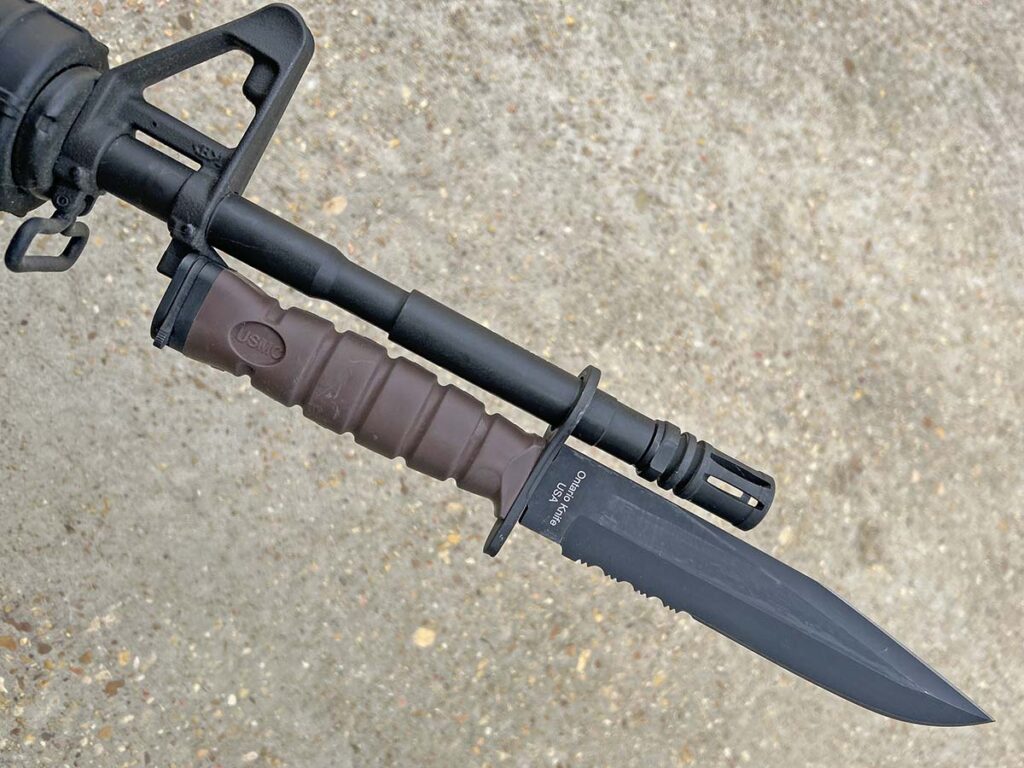
One of U.S. Marine Les George’s teammates mounted an Ontario OKC-3S similar to this one on an M4 to help quell a tense situation on the streets of Fallujah. (Les George image)

The Applegate-Fairbairn dagger and Gerber A-F folder were named after Cutlery Hall-of-Famer Col. Rex Applegate and W.E. Fairbairn
of Fairbairn-Sykes Commando Knife fame.

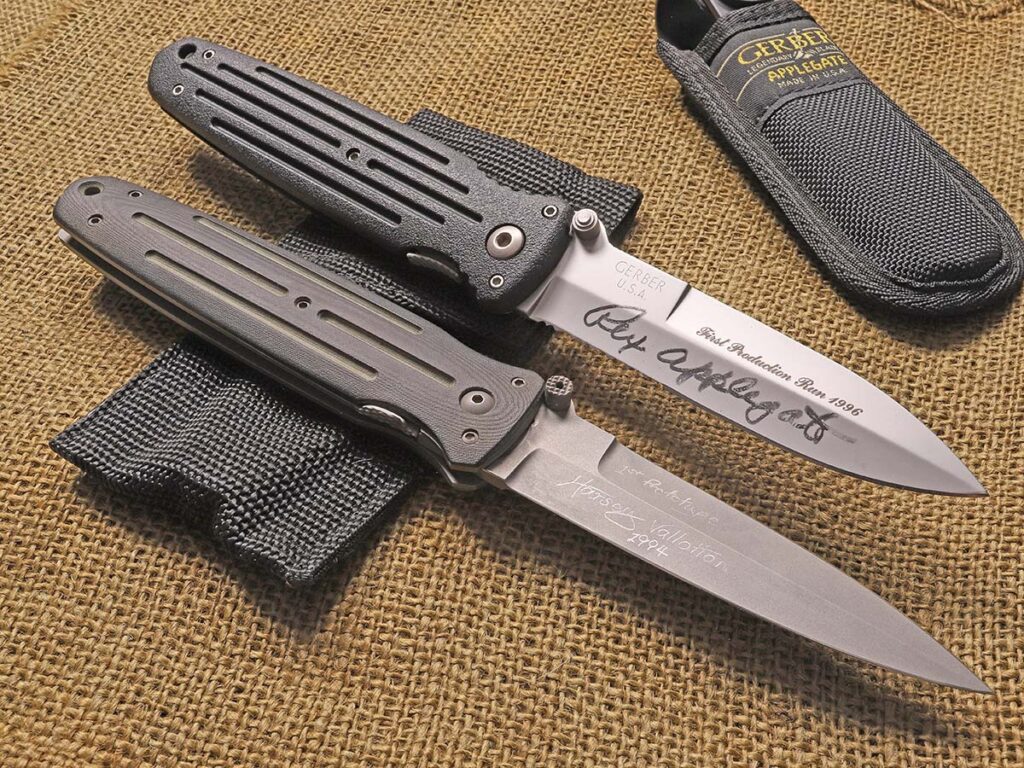
“Another design that corrected the flaws of the Fairbairn-Sykes dagger was the Applegate-Fairbairn dagger,” Janich observed. “Designed during World War II by Col. Applegate and W.E. Fairbairn, it never got beyond the prototype stage before the war ended. Decades later, it finally saw production by several major knife companies. Although very noteworthy on its own, it also inspired a scaled-down folding version that set a new and different standard in folding and fighting knife design. The original A-F Folder design was a collaboration between Col. Applegate and consummate custom knifemakers Bill Harsey and Butch Vallotton.” Added Harsey, a Cutlery Hall-of-Famer in his own right, “The Gerber version of the folding knife was a long-running project, and I was told by Gerber that the Army ordered 50,000 pieces at one time for the troops, which were delivered.”

Few knives enjoy legendary U.S. military status as much as the SOG Bowie, which served as the inspiration for the name of today’s SOG knife company. “The Special Forces SOG Bowie is one of the most iconic knives associated with American special operations forces,” Iovito wrote. “Inspired by the knife carried by members of the Military Assistance Command, Vietnam Studies and Observations Group during the Vietnam War, the SOG Bowie reflects a fusion of classic bowie knife design with modern military needs. Its lineage connects directly to clandestine operations carried out in Southeast Asia, where unconventional warfare units often relied on rugged equipment that could handle jungle conditions and extreme use.”

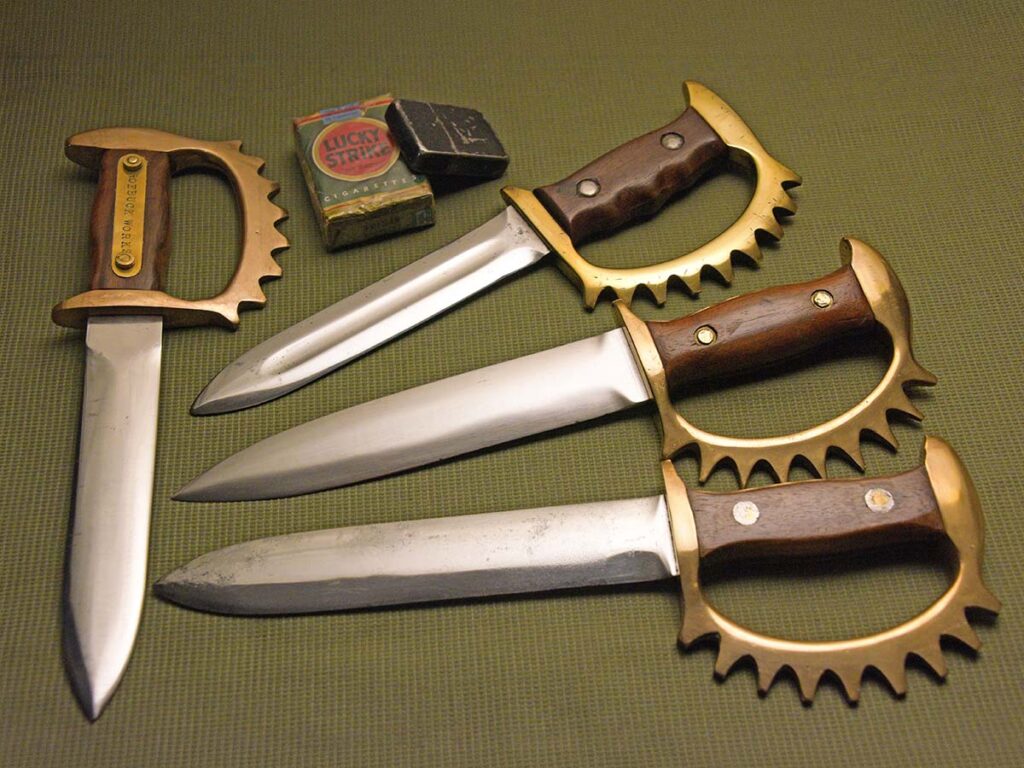
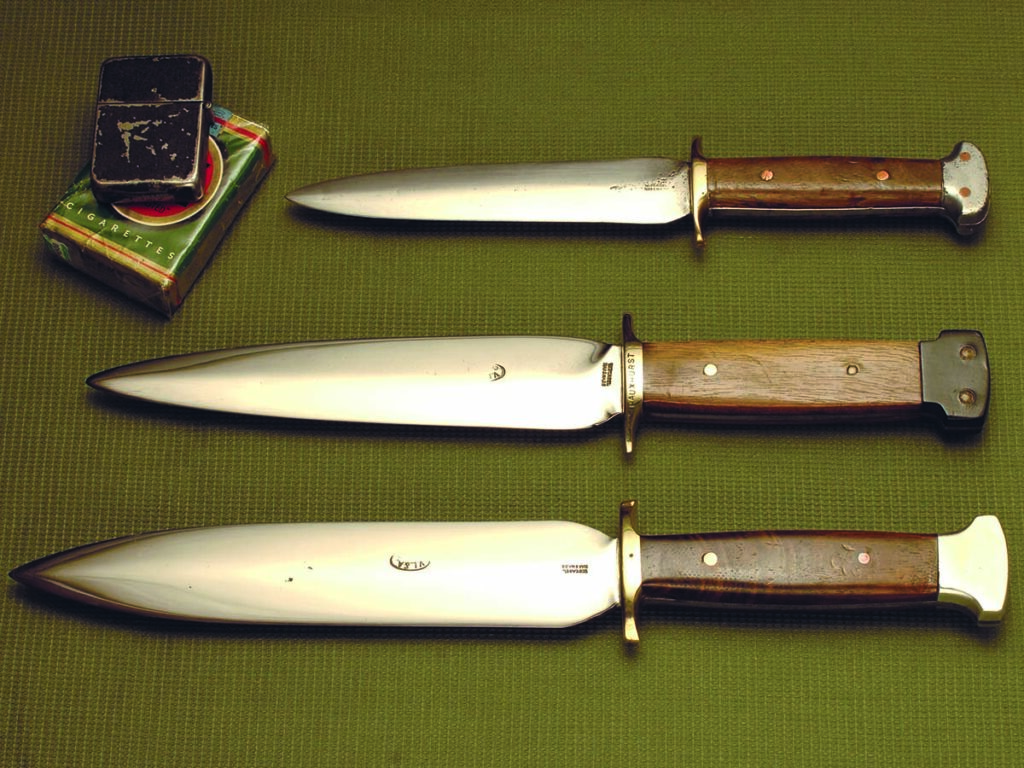
Howard Cole was famous for making knuckle knives such as these three rare nine-pointers and one eight-pointer. A paratrooper named Clyde McClelland carried the center nine-pointer during World War II. (Image courtesy of Louis Chow)

Folding knives have never been so popular in the U.S. military as they have in the past 40 years, and at or near the top of that list are the Al Mar SERE, CRKT M-16 and Spyderco Endura.


“While many earlier military knives were fixed blades, modern soldiers frequently rely on folding knives for everyday field use. One of the most influential examples is the Spyderco Endura,” Janich began. “For me, the knife carries a very personal meaning. During Operation Just Cause in Panama, I found myself tangled in my parachute harness after landing while under fire. I used my Spyderco Endura to cut myself free from the harness so I could move and get back into the fight. That moment left an indelible mark on me and reinforced the reality that sometimes the most important piece of equipment you carry is the knife in your pocket. The Endura is lightweight, corrosion resistant and extremely functional, and its opening hole allows rapid one-handed deployment, even with gloves. Its reliability and practicality have made it a favorite among soldiers who need a dependable cutting tool for daily field tasks.”

In the fall of 1984, Harsey helped Al Mar do a run of just over 50 large folders for Col. Nick Rowe, who had been tasked by the Army to run the SERE (Survival, Evasion, Resistance and Escape) School near Fort Bragg, North Carolina. “All modern Special Forces soldiers, aka Green Berets, and other high-risk military members including pilots undergo this training,” Harsey stated. “I finished my part of unmarked knives in time for Al Mar to get them on an airplane bound for Fort Bragg and into Col. Rowe’s hands for an important mission date. I never heard another thing about this project. Later this knife would become known as the AL Mar SERE folding knife.”

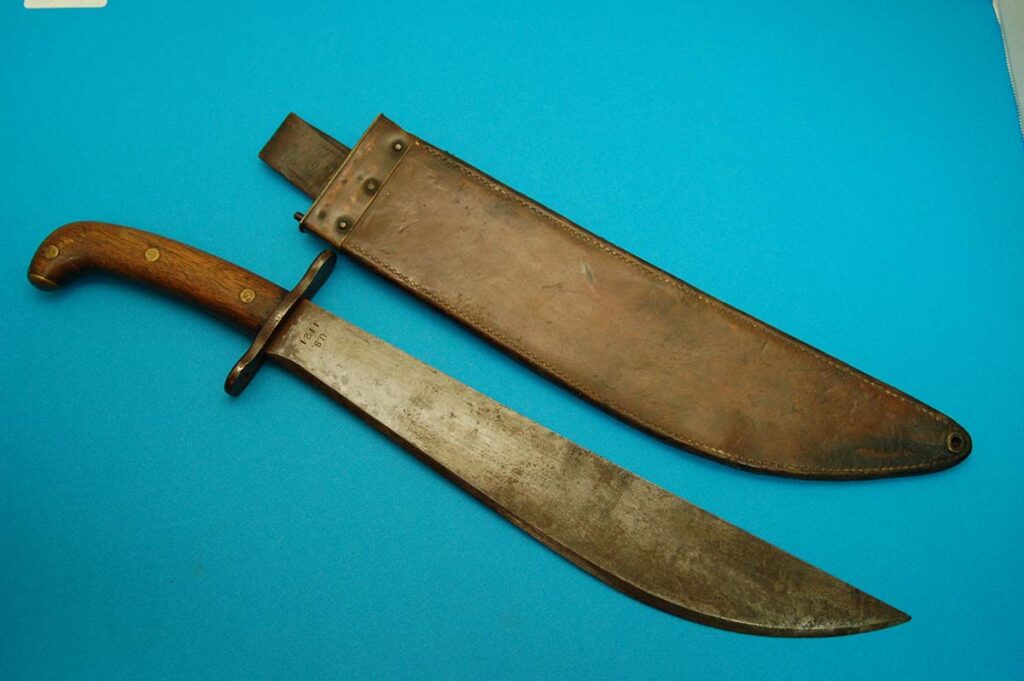
The Field Artillery Corps designed the Model of 1909 bolo for use by crew-served weapons during World War I. It was for clearing fields of fire to enable the limbers and horses to navigate the towed artillery into place. (Images courtesy of Frank Trzaska)

As for the CRKT M-16, its universality during the Iraq War guarantees its spot on the list. “I am not aware of this knife ever being issued but there was a time when you saw them everywhere,” George wrote. “Guys would buy them at the PX and clip them on the outside of their vests. They were everywhere, and they did everything!”

Standard Setters

The foregoing includes but a few of the knives that have served the USA and served it well over 250 years of saving the world from tyranny and oppression and setting the standard billions aspire to today. Other notable knives, in no particular order, include:

The M9, M11 and OKC-3S bayonets; Camillus Jet Pilot Survival Knife; Chris Reeve Yarborough; OSS Smatchet; Collins M1942 Machete; Swiss Army knife; Spartan Blades Ares, Difensa and Harsey Dagger; Randall Models 2 and 18; Gerber Silver Trident Knife and Mark I; G.I. four-bladed pocketknife; Schrade Mark II Paratrooper switchblade; G.I. Machete; Leatherman and Gerber multi-tools; and Western 49 Bowie.

According to Army Special Forces veteran Curtis Iovito, the Special Forces SOG Bowie reflects a fusion of classic bowie design with modern military needs. “Its lineage connects directly to clandestine operations carried out in Southeast Asia,” he wrote, “where unconventional warfare units often relied on rugged equipment that could handle jungle conditions and extreme use.” (Frank Trzaska’s knife and image)

Which ones are we omitting? Let us know. And while you celebrate the semiquincentennial of your favorite nation throughout the year, never forget: knives have played a monumental role in the success of the U.S. military and the building of the USA up to now and for the foreseeable future.

It doesn’t get much sharper than that.

*Though they are two different knives, the USN Mark II and USMC fighting/utility knife are grouped together for the purposes of this story because of their similarity in design and their across-the-board use by U.S. service personnel, especially during World War II. Also, the spelling of KA-BAR refers to the knife manufacturer that continues in operation, while Ka-Bar refers to the generic name service personnel gave the knife, a name that persists to this day.

Military Knives:

Feather Damascus: Blades Forged Light And Airy

The variations on damascus steel themes are endless. The possibilities are tempered only by the maker’s time at the forge and his or her desire to create.

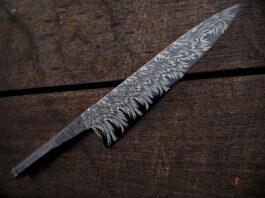
Among these many variations, one pattern has recently captured the spotlight. These days, feather damascus is trending and custom makers are producing knives that turn heads, captivating buyers with the intricate layering that produces hard steel intertwined with the look of the light and wispy. Feather damascus offers a medium of both performance and artistic expression that influences every aspect of the maker’s creativity.

Ethan Kolar of Plummer, Idaho, describes his interest in feather damascus as “chaotic flow.” He explains, “The pattern’s center seam, where the jagged W’s converge, creates a flow in the blade which really adds to the overall confluence of the knife as well as creating a controlled chaos as the pattern explodes from the center filling out the blade.”

Kolar enjoys the hint of “jaggedness” and the center line that ties the blade together, and in the making of his feather damascus, his focus lies in test etching every restack from the forge. He sees the pattern in many different forms with the observation that “a pattern is not right or wrong but more of what the maker envisions and creates and what is right to him for his knife.”

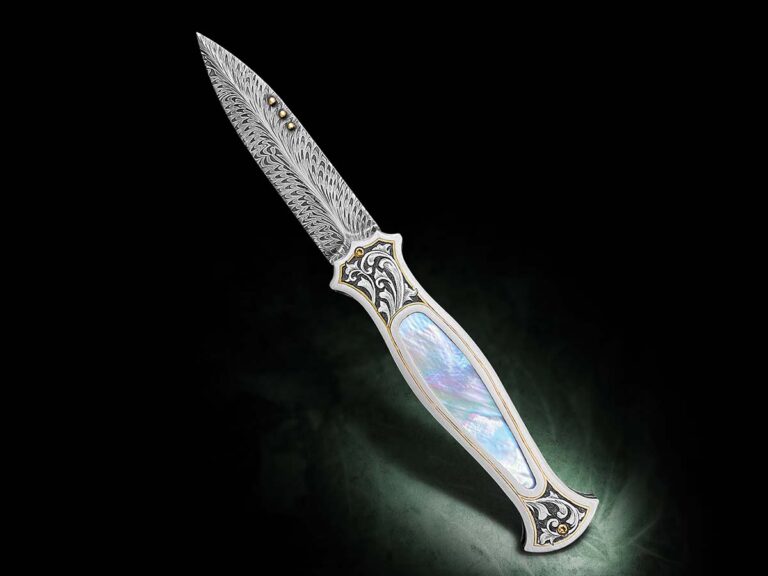
The folding dagger Ethan composed includes a 3-inch feather damascus blade of 1084 and 15N20 steels with an engraved gold inlay and scroll worked 416 stainless steel window frame fitted with exhibition-grade white-lip mother of pearl. Liners are 15N20 file-worked and nitre blued, while the backbar of 416 stainless is engraved and sports delicate file work. Its overall length is 7 inches.

“Most of the inspiration I have while making damascus comes from envisioning my final product,” Ethan remarked, “what engraving will go with it, the handle embellishment, and a lot to do with the overall color of the knife, deciding whether the pattern will be brighter or darker.”

Steel On Fire

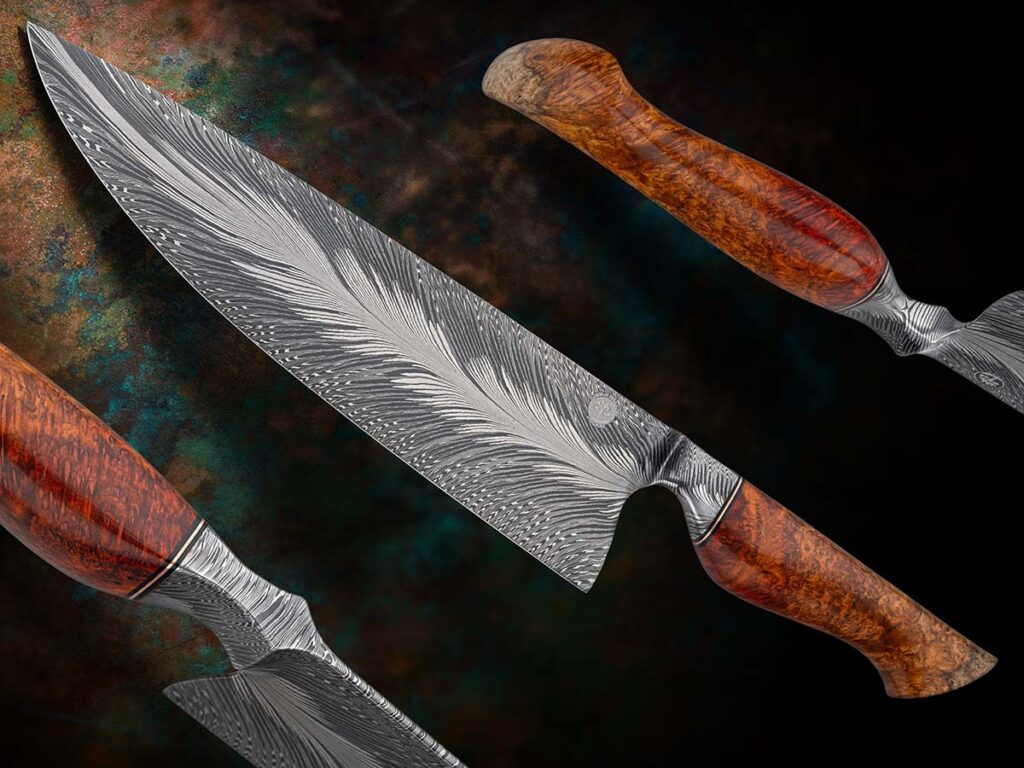
Winning Best Damascus at the 2025 BLADE Show West, Trevor Morgan’s “Torrent of Fire” chef’s knife includes a 9.25-inch blade of 1084 and 15N20 in a mix of W’s and straight layers with a fat core of 15N20. The knife’s overall length is 14.2 inches, and the handle is dark red tiger’s blood amboyna burl with a splash of sapwood for contrast. (Jocelyn Frasier image)

Another contemporary artisan exploring the feather damascus pattern is ABS journeyman smith Trevor Morgan. Having attended the Bill Moran School of Bladesmithing in Texarkana, Texas, in 2020, his goal with each feather damascus blade is to make the pattern “pop.” To achieve that look, his hand follows an artistic eye.

“Contrast, for sure, really makes any pattern cool,” said Trevor, “especially feather or mosaic damascus, larger pieces of dark and bright steel, gradients and that kind of thing. Also, out-of-the-ordinary stuff like feather [damascus] can be really cool to look at. Symmetry is always great with a feather pattern because it’s pretty easy to notice when something is out of whack with a feather due to the defined center. Complexity is also great. If it’s hard to figure out, all the better.”

According to Morgan, a resident of Apple Valley, California, the feather pattern can be challenging due to the hot-cut process, which puts enormous stress on the billet in somewhat weird ways and causes every forge weld to want to split open. The problem, however, can be mitigated by mig welding all the way around the seams. But this is his least favorite method of achieving the integrity of the billet because it requires grinding away the welds, wasting material and consuming time.

Trevor’s inspiration for feather damascus pieces comes from the world around him. “It’s places and people,” he commented, “from nature and the endeavor to make something organic and as lifelike as possible in steel. I regularly get swept up in the general zeitgeist surrounding the making of complex patterns. I see something on social media or somewhere, and I think, ‘Man, that’s really awesome! I’d love to try to make something like that.’ Then comes the real creative part, where I just get an idea of something that might look really cool and put it together.”

Morgan’s method is readily revealed in his featured piece, named “Torrent of Fire.” The knife includes a 9.25-inch blade of 1084 and 15N20 in a mix of W’s and straight layers with a fat core of 15N20. The knife’s overall length is 14.2 inches, and the handle is dark red tiger’s blood amboyna burl with a splash of sapwood for contrast.

Organic Appeal

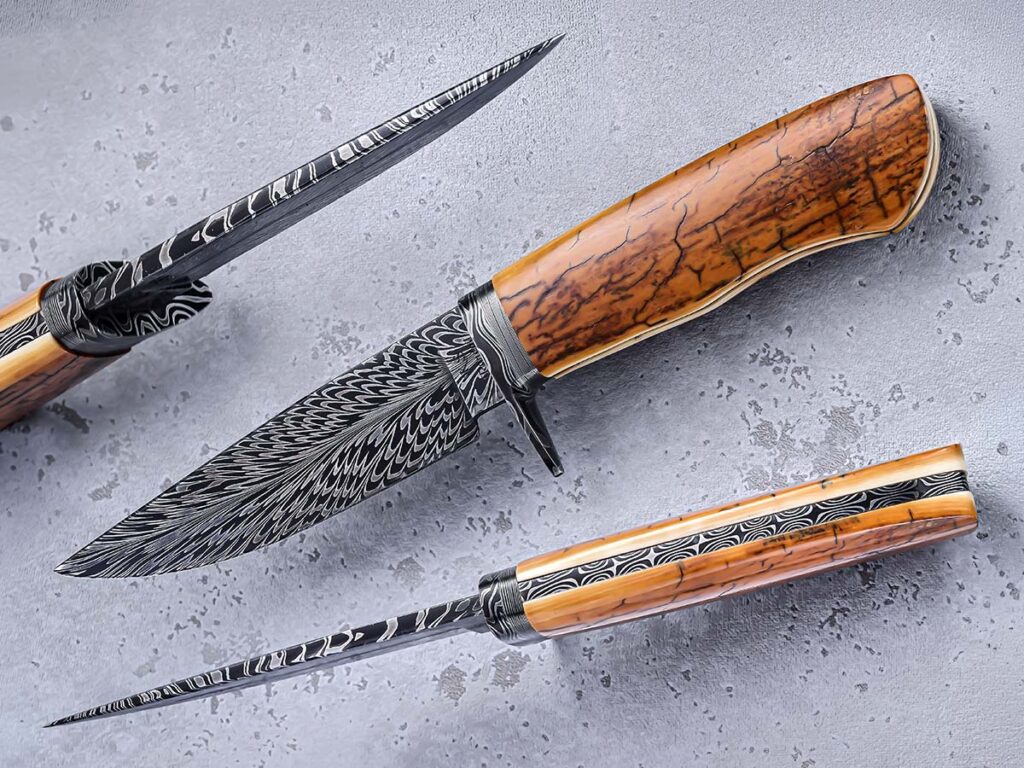
Splitting the billet down the center to maintain symmetry is among the trickiest aspects of feather damascus to Steve Randall. He nails it on his frame-handle hunter, with the axis of the pattern fountaining from the mastodon scales in a balanced and spectacular fashion. (SharpByCoop image)

Feather damascus has been a staple steel for ABS master smith Steve Randall for some time. He seeks a continual flow of the steel from the handle to the tip, and oriented so that the handle appears to actually hold a feather. “I was attracted to the feather pattern because of it’s a very cool, organic look,” he advised. “Like a snowflake, there are no two exactly the same. I’ve been forging feather damascus for at least seven years, and I’ve made several bowies and hunters.”

Randall, of Estancia, New Mexico, presents his feather damascus piece with frame-handle construction, showcasing mastodon scales with an overall length of 9½ inches and a blade of 4¾ inches. “Feather damascus is a more challenging pattern,” he said. “My tricks are patience and concentration. There are many welds involved in the pattern, which can contribute to cold shuts, which can destroy hours of hard work. The trickiest part is splitting the billet right down the middle and maintaining symmetry.”

While he describes the feather damascus forging process as complicated and labor-intensive, Steve sees the payoff in the harmony of the pattern and its related materials in the finished knife. “I always try to complement it with the best handle materials I have available,” he reasoned. “I prefer stag or ivory. If using wood, I avoid busy patterns and colors. I draw inspiration from many other makers. There are so many accomplished makers who produce a variety of feather patterns. It is one of my favorite patterns to forge because it can really accent the flow of the blade and give it a great overall look.”

Movement And Flow

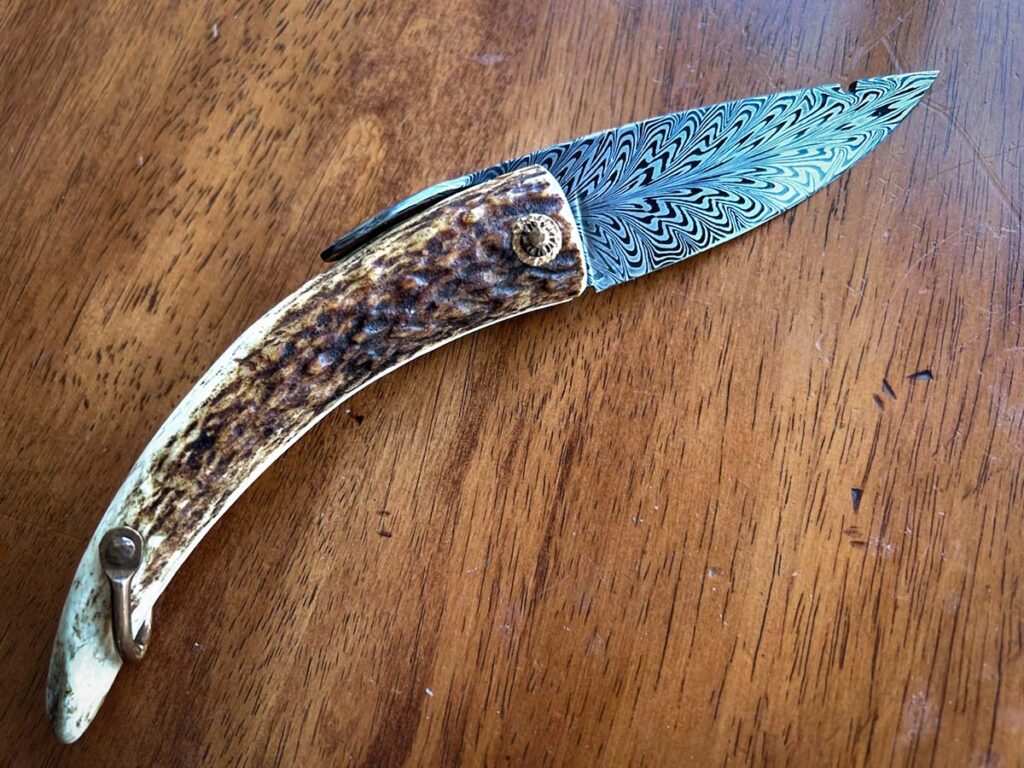
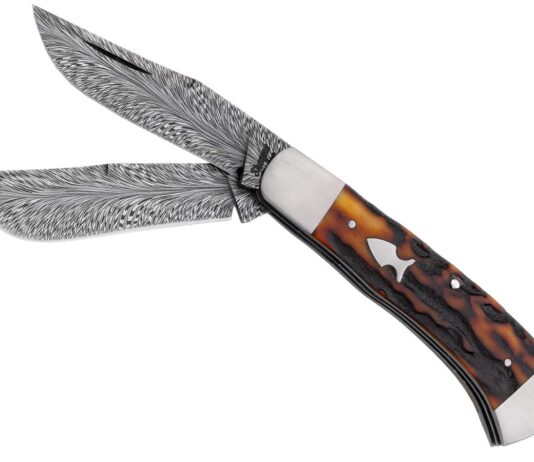
While David Lisch doesn't feel he's hit the limits of his Mountain Man folder, the style of knife is striking with its feather damascus blade set in stag-tip handle. Copper hardware and pivot give the knife its antediluvian look, while the flowing pattern of the blade anchors it in modern forge techniques. (David Lisch image)
While David Lisch doesn’t feel he’s hit the limits of his Mountain Man folder, the style of knife is striking with its feather damascus blade set in stag-tip handle. Copper hardware and pivot give the knife its antediluvian look, while the flowing pattern of the blade anchors it in modern forge techniques. (David Lisch image)

It took a single demonstration by the great master smith Harvey Dean to convince David Lisch, who earned his ABS journeyman stamp in 2009 and his master stamp six years later, to try the feather pattern. “I was always attracted to feather damascus,” he remembered, “but around 2008 I had the chance to see Harvey Dean demonstrate it at an event at Josh Smith’s, and I went right home and made the tools needed and gave it a go. I’ve been making feather damascus since his demo, and my hat is off to Harvey.”

For David, the making of feather damascus is challenging, but he says book matching the blocks really helps with the constant flow of the pattern. Sometimes, he says, makers will intentionally disrupt the flow by spinning one block one way and one the other to enhance the look. If it is done intentionally, he advises, there is no wrong way to stack the blocks. Forging all begins with the initial stack, and David starts with a 12- to 15-pound billet, acknowledging that the pattern can be wasteful in material. He tries not to go too far or stop too short in the forging process and offers that sometimes less is actually more.

“I love feather damascus because it looks different from maker to maker,” added Lisch. “I like a feather with movement and flow, not too bold and not way too fine, something that is easy to look at. For me, the more the pattern follows the forging, the more I like it. The center should lift up into the bolster or ricasso, showing that the blade was forged rather than running off the blade under the ricasso, showing it was just ground into a shape that disrupts the flow.”

Lisch gained a measure of popularity with his Mountain Man 2 folder, and the pictured knife is an example of what he describes as a “deep dive” into the style while using stag tips. “I set out trying to create my own version of one of the oldest knife designs in America,” he remarked, “and I believe I did just OK. But I’m not finished. So far, I’ve made several versions of the folder and have taken it even further with help from my friend and mentor [master smith] Mike Vagnino.”

Lisch had brought together his feather damascus touch and innovative design composition by introducing a clocking adjustable pivot that he has incorporated into a slipjoint, linerlock, lockback and flipper, all in the Mountain Man style with bronze, copper, stag and, of course, feather damascus. He has yet to reach the outer limits of his Mountain Man creativity and says that more will come in due time.

Check Out More Cool Customs:

Brazilian Bonanza: A Bevy Of Brazilian-Made Custom Blades

Hot custom knives from Brazilian makers.

There must be something in the Amazonian water. In the global phenomenon of custom knives, there are few geographic locales that sizzle hotter than Brazil. The country has sharp makers and attracts talent, creating some of the world’s most desirable knives. Here is a look at some of the steel expertise emanating from the equatorial nation and its cutlery shows.


Romário Ribeiro Fighter

Romário Ribeiro Fighter

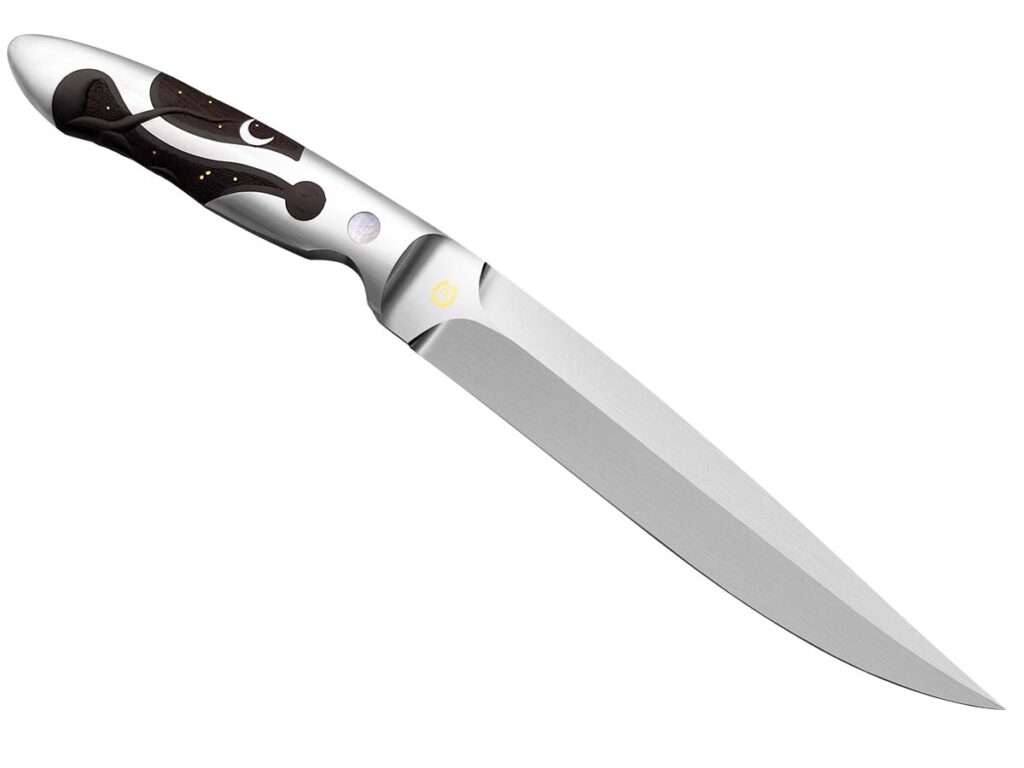
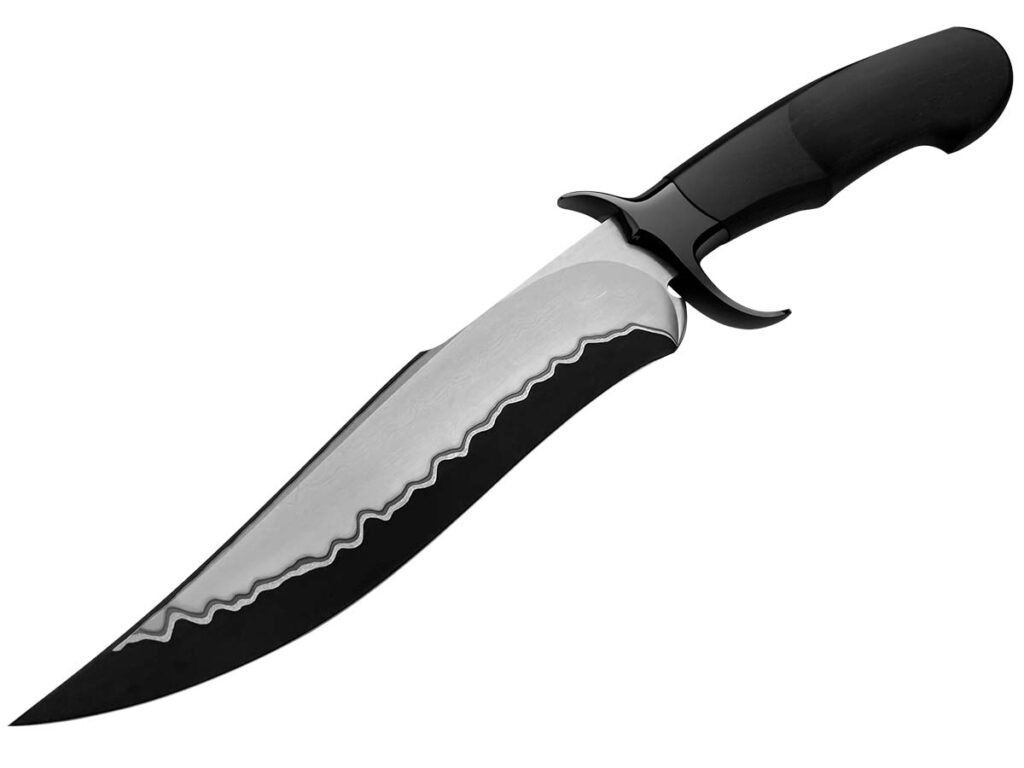
Sleek and dark, Romário Ribeiro’s 12-inch fully integral fighter of 52100 carbon steel won the Best Handle Award at Salão Paulista de Cutelaria 2025. It’s no wonder, with a seamless and intricate keyhole-style construction, and jacaranda wood and 24k gold inlays creating a boundless night sky motif, complete with a rising crescent moon.


Gustavo Schuenck Fighter

Gustavo Schuenck Fighter

Winner of the Best Fighter Knife Award at Salão Paulista de Cutelaria 2025, Gustavo Schuenck’s blade is aggressively beautiful. San mai steel of 9½ inches with a black phosphate finish ties together with the knife’s pitch-colored jacaranda handle. The nuanced recurve toward the heel offers flow in the build, paired with an understated yet sweeping guard.


Alexandre Biguna Bowie

Alexandre Biguna Bowie

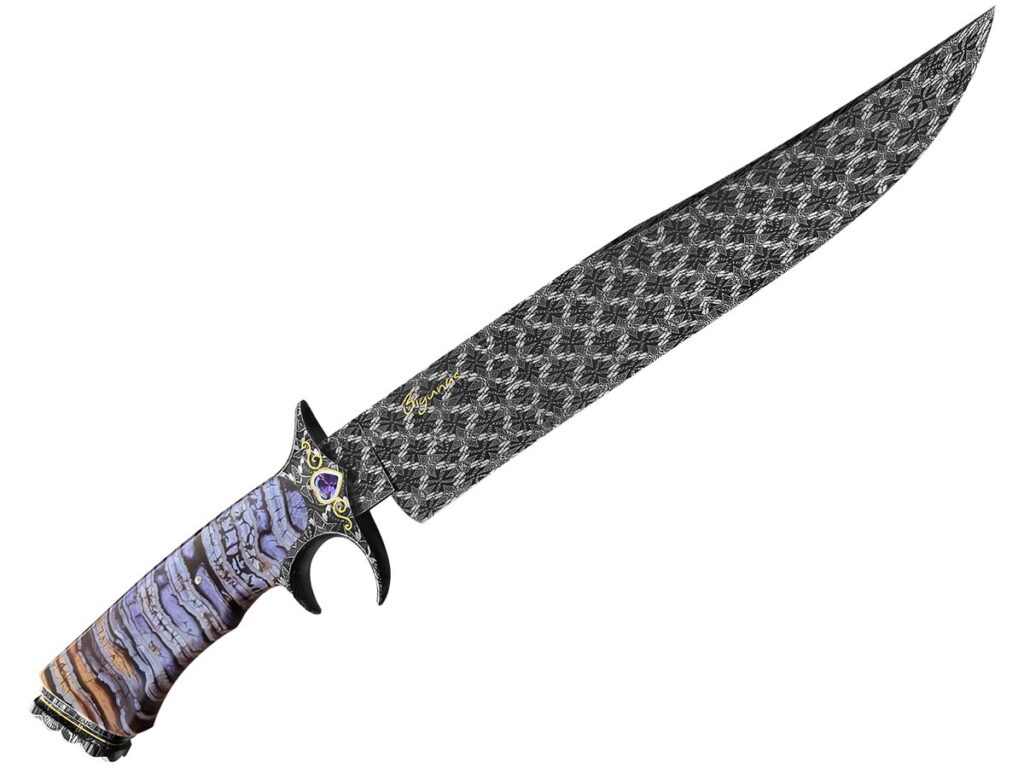
Near-perfect symmetry of Alexandre Bigunas’ basketweave mosaic damascus bowie can’t help but fascinate. The meticulous work on the 10-inch blade is contrasted by the striking color of the sub-hilt’s mammoth-molar handle and pair of amethyst stones on either side of the guard. Topping off Bigunas’ work, 24k inlay, including his signature on the blade.


Júlio Cézar Ribeiro Gentleman’s Slip Joint

Júlio Cézar Ribeiro Gentleman's Slip Joint

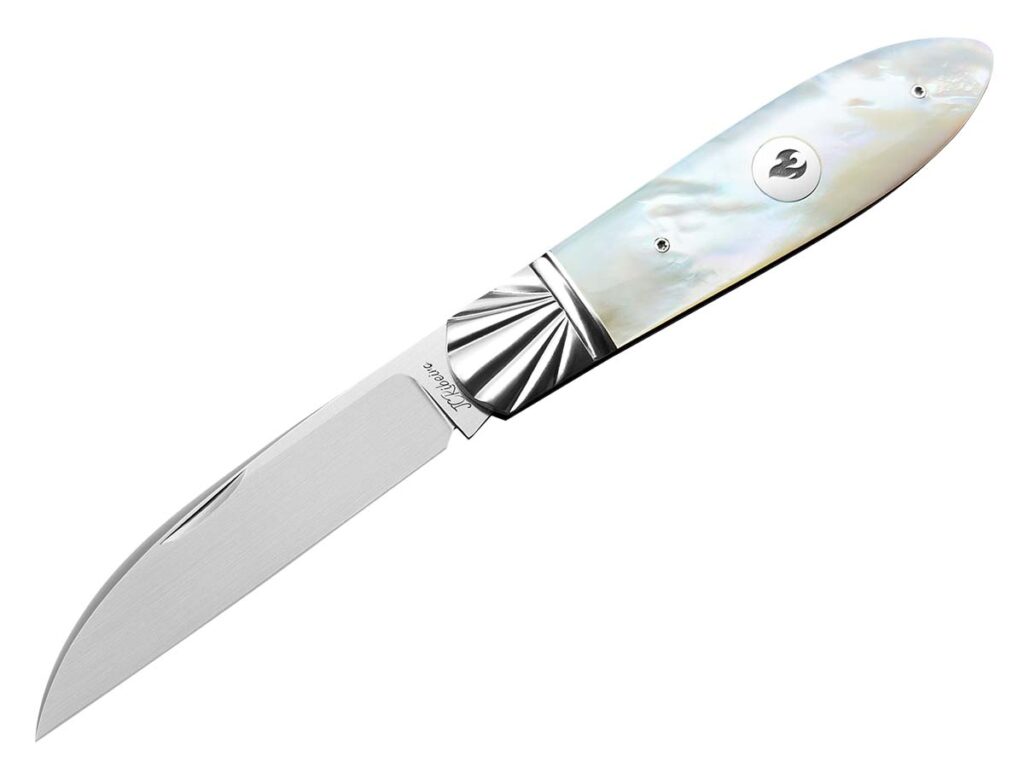
Simple, clean and classy are the driving ideas behind Júlio Cézar Ribeiro’s gentleman’s slip joint. The Brazilian’s spotless execution also caught the judges’ eyes at Salão Paulista de Cutelaria 2025, with the knife winning Best Traditional Folder. Notable aspects of the knife includes the swooping spine of the RWL 34 steel Wharncliff blade, maintaining the knife’s overall geometry with its teardrop mother-of-pearl handle.


Lizandro Bertoni Bowie

Lizandro Bertoni Bowie

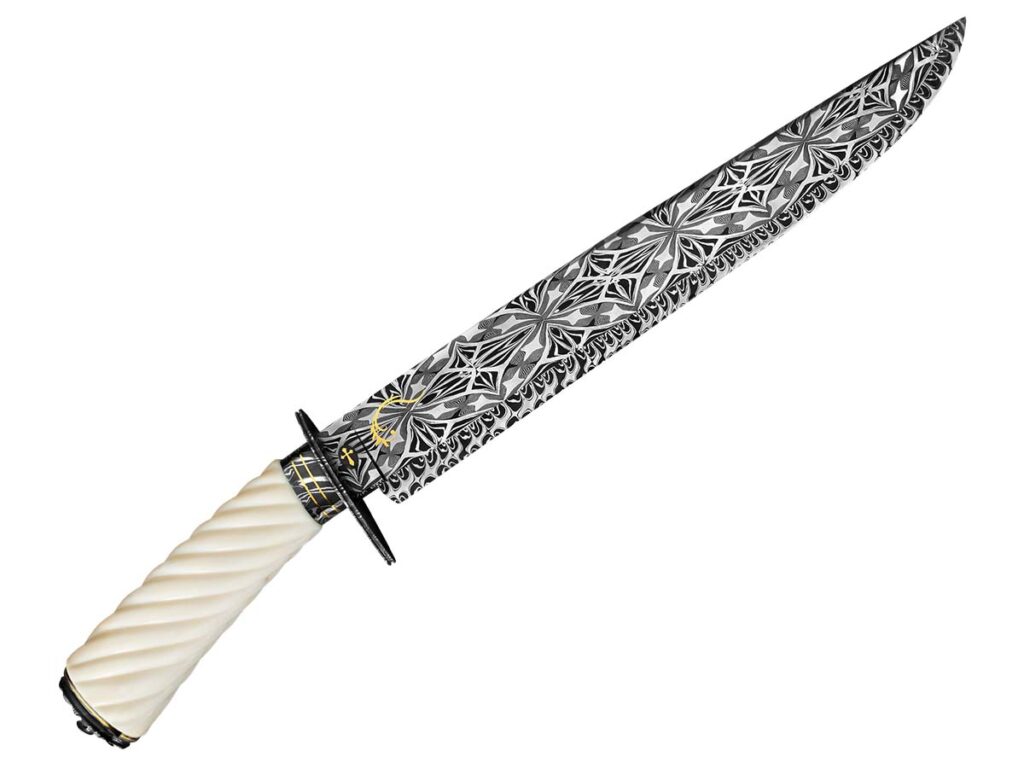
Lizandro Bertoni’s bowie is a study in contrasts. The flats of the 16-inch, 1085 and 15N20 damascus blade dominate with a starburst-like mosaic pattern, but give way to a cross pattern at the edge. Further, the busy ornamentation of the blade is contrasted with the calmer design of its walrus-ivory handle and the smooth lines of its texturing.


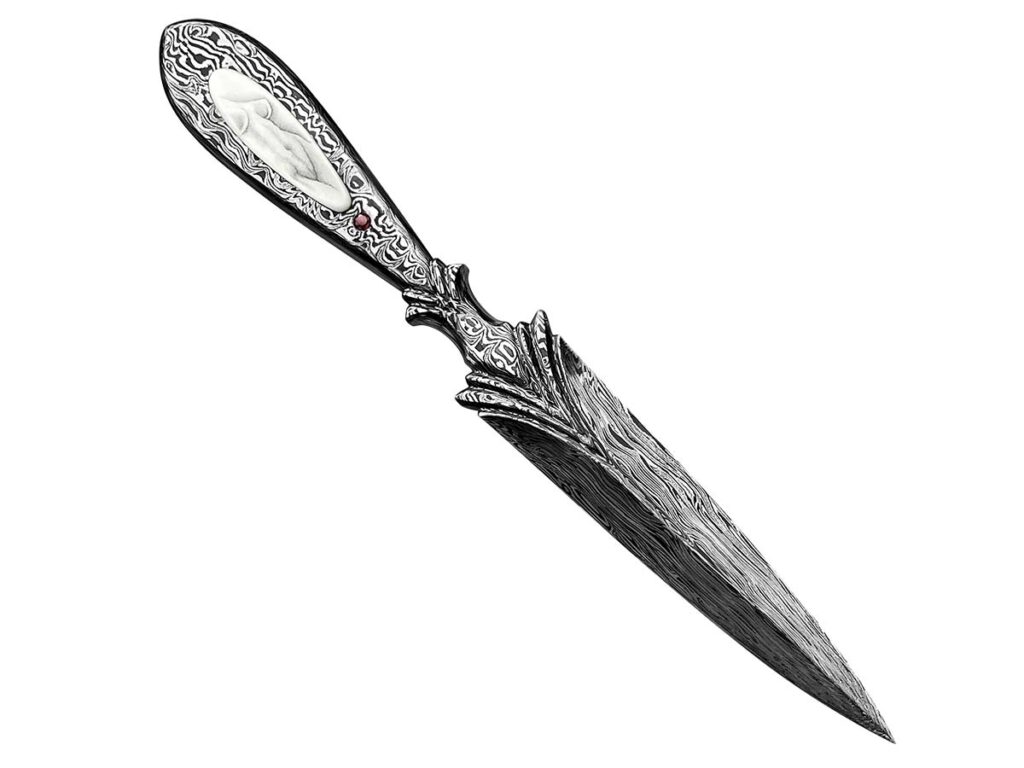
Vanuti Fiori Dagger

Vanuti Fiori Dagger

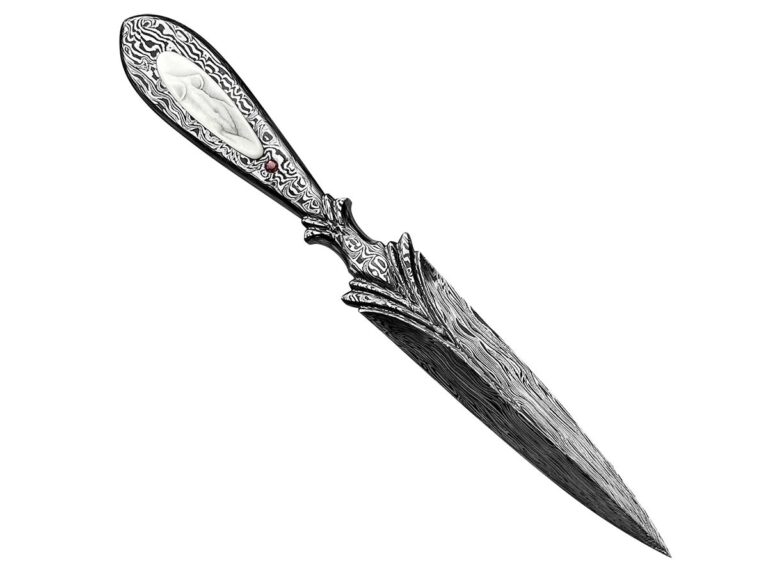
Dang sexy is all that can be said of “Lady of the Night,” a collaboration between knifemaker Vanuti Fiori and engraver Gabriel Krebs. It’s not only the lines of Fiori’s integral dagger that drip sex appeal, but also Krebs’ alluring feminine -form scrimshaw on its mother-of-pearl inserts.


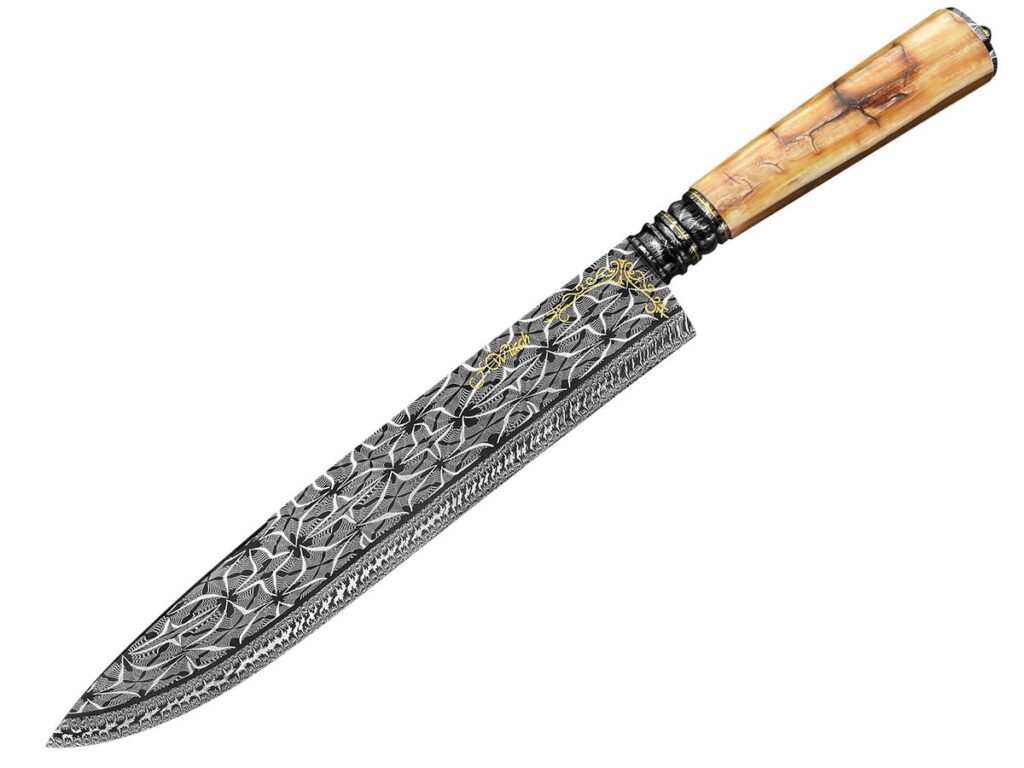
Francisco Wlach Gaucho

Francisco Wlach Gaucho

Francisco Wlach takes the workingman’s gaucho knife to a different level with the execution of his knife’s 10-inch laced mosaic blade. Wlach creates movement on the blade with a very uniform pattern over the majority of the steel, contrasted by a more subtle pattern along the edge. Gold inlay, integral bolster and mammoth-tooth handle would make this blade any gaucho’s pride.


Check Out More Cool Customs:

Cool Custom: Jon Christensen’s Mythical Undertaking

Guardian Sword proves a painstaking quest.

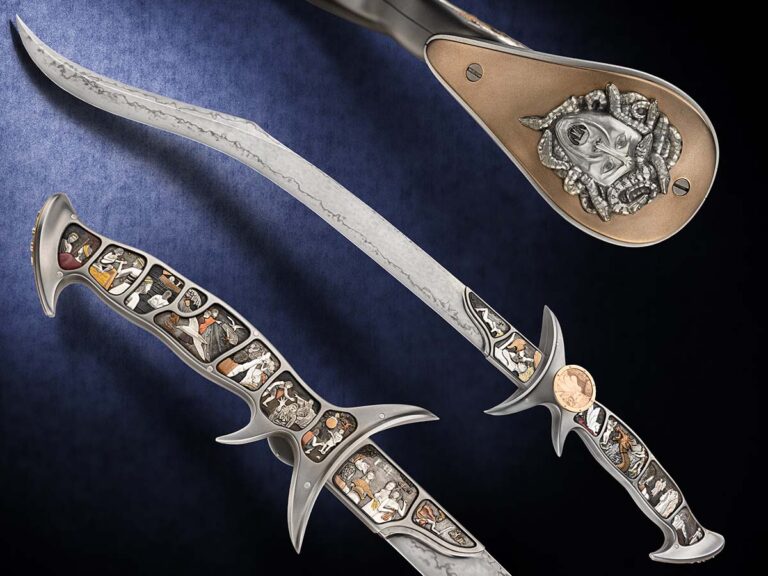
It’s easy to toss around the word epic and difficult to describe Jon Christensen’s recent work any other way. Of course, the subject material for his two-handed sword made it challenging for the results of the project to be anything other than mythical.

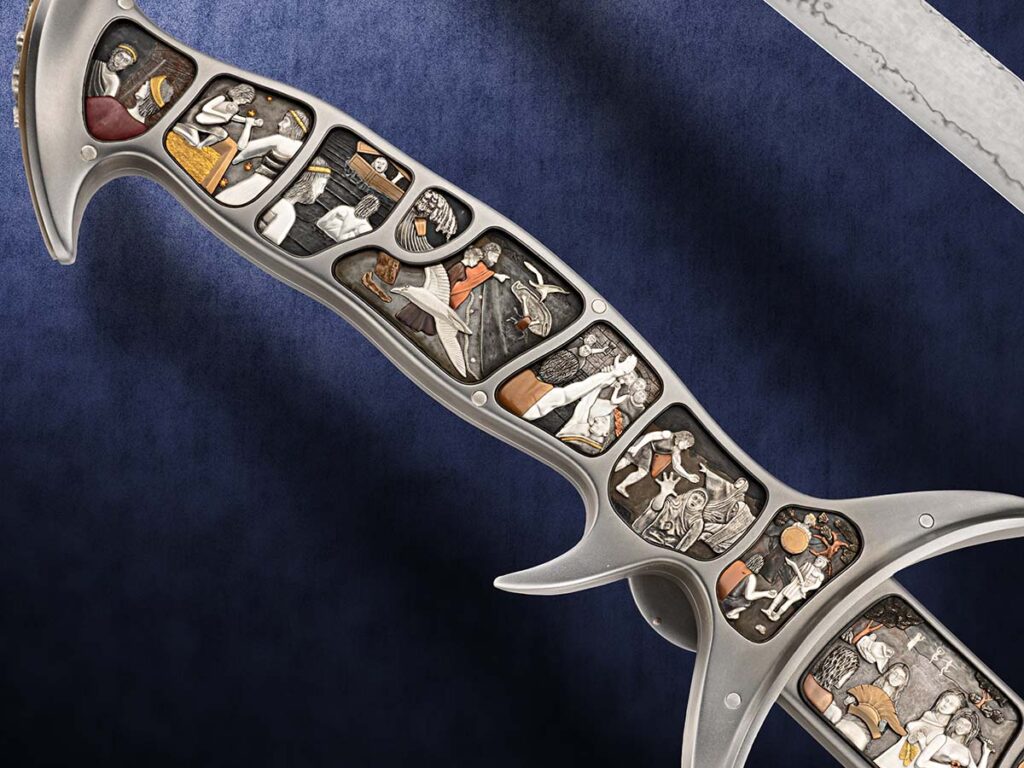
The Montana-based ABS master smith captures the ancient Greek myth of Perseus and Medusa in 16 hand-engraved iron panels inset into the 410SS handle and a bulino-engraved bronze shield on the guard of his Guardian Sword. Among other things, the handle features gold, bronze, copper, silver, custom alloy and mother-of-pearl inlay and is punctuated with Medusa’s head on the butt.

Jon Christensen
Jon Christensen

“The bulino engraving was very challenging as it was my first,” Christensen confessed. “There was a ‘paying my dues’ stage of time spent, which I just had to accept.”

It might be said that the entire project was an exercise in dues-paying. In addition to challenging himself with a new engraving technique, he was also delving into an unfamiliar subject. Christensen gave himself a crash course in the story of Medusa before conceptualizing the panels. But the client who commissioned the sword raised the bar on his retelling of the myth.

“Before starting on the project, the collector requested my interpretation of the story be approved by Tufts University, which is known for a strong program in classical mythology,” he said. “I compiled and submitted a document of the concept showing drawings and descriptions for each scene, as well as the overall sword. They replied saying, ‘It was a masterful interpretation.’”

The Guardian Sword handle, with the panels depicting the Greek myth of Perseus and Medusa.

The sword is reminiscent of the one featured in Benvenuto Cellini’s sculpture of Perseus, showcasing the same unique shape in its 37.5-inch W2 blade, with a hamon. While this aspect of the sword presented challenges, Christensen admits it was the easy part of the Guardian. Much of the 4,000 or so hours he dedicated to the work were focused on the handle, engravings and accurately retelling the ancient myth.

“The time on completing the blade would be measured in weeks, the handle scenes in years working under a microscope,” he said.
Epic, indeed.

“Yes, the scope of the project was very intimidating at times. I had to constantly manage my thoughts to the task at hand,” Christensen said. “As the saying goes, ‘How do you eat an elephant? One bite at a time.’”

Check Out More Cool Customs:

Military Knives: Historic Star-Spangled Steel

Few knives have served America more than those of the U.S. military.

Editor’s Note: This is the first of a two-part series on the most influential knives to serve the U.S. Military and explores some of the early influences on military knife design.

As what many call the greatest country in the history of countries approaches its 250th birthday, now’s a good time to salute some of the top knives that played pivotal military roles in the forging of the world beacon that is the United States of America.

It is, of course, impossible to recognize in one magazine story every single knife that played a crucial role in the many battles of the wars fought by the USA. However, with the help of some of the knife industry’s leading military authorities—including several of whom have seen the elephant in service to our nation—BLADE® will endeavor to touch on some of the more consequential knives of U.S. military history.

Before embarking on such a quest, the first task is to identify a basic group of the most indispensable knife types over two-and-a-half centuries of American land warfare. At the risk of omitting one or more, five stand out: bayonet, all-purpose utility fixed blade and/or bowie, dagger, machete/chopper and utility folder.

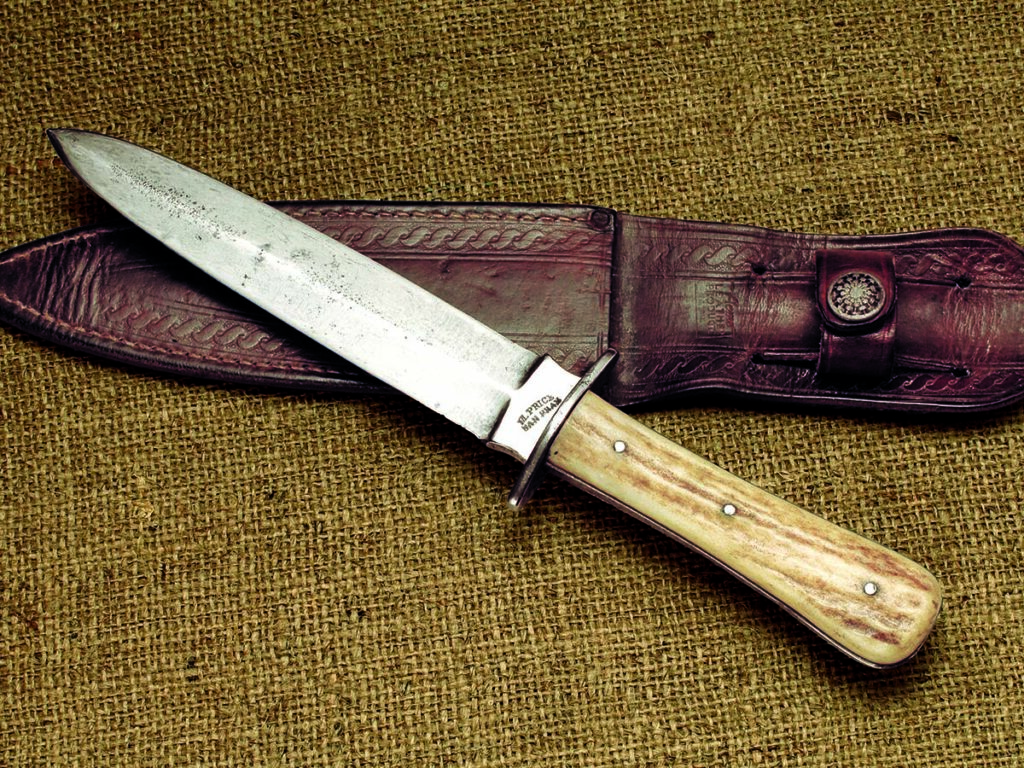
Michael Price recognized that to create a viable knife for self-defense and combat, form must follow function. His solution was to use the full-tang construction method, here on one of his classic mid-19th-century daggers. (Image courtesy of Louis Chow)

“These encapsulate everything that an infantryman used during the 250-year history of our country,” noted Louis Chow, a 24-year U.S. Army veteran who retired with the rank of major and is one of the leading collectors of the knives of BLADE Magazine Cutlery Hall-of-Fame® member Bob Loveless. “The bayonet, of course, from the get-go, from the Revolution to today.”

Louis indicated the all-purpose utility fixed blade/bowie could include privately purchased knives such as the Randall Model 1 and, of course, double-guard bowie types like the USMC fighting utility knife, aka the Ka-Bar. He pointed to the mid-19th-century designs of Michael Price as highly influential on daggers through to today, and machetes such as those made by Collins used in the Spanish-American War and before to Vietnam as vital to U.S. war efforts. Though pocketknives were indeed carried by American patriots during the Revolutionary War, the utility folders to which Louis referred are more of the modern Leatherman/Gerber multi-tool type, not to mention the Buck 110, Al Mar SERE, CRKT M-16 and others. As Louis noted, almost every soldier, male or female, in the modern military carries a multi-tool folder.

Many knife enthusiasts know that bayonets are rarely, if ever, used in combat today, nor have they been for well over a century. “It’s hard to actually find someone who used one in combat,” Louis said. Probably the most legendary American bayonet charge was the eminently successful one by Union forces led by Col. Joshua Chamberlain against Confederate troops down a hill called Little Round Top, a major turning point in the Battle of Gettysburg and, of course, the entire Civil War. Ironically, as Louis noted, “the most famous bayonet charge of all was the last one.”

While bayonets have rarely been used in American combat for many decades, that does not mean they do not remain significant teaching tools in today’s U.S. military. “When I was a company commander in 1990, we trained with the bayonet,” Louis recalled. “There are established bayonet courses on every installation, such as Fort Hood in Texas and Fort Benning in Georgia, and we would go there and train with the bayonet.” The rifles and bayonets have changed over the years but the bayonet training techniques remain the same.
Throughout U.S. and nearly all other nations’ histories, governments have been responsible for the issuance of combat knives in the form of bayonets for their infantry fighting forces. During World War II, the USA issued all-purpose fighters and utility knives to many soldiers, sailors and airmen. However, as Louis noted, privately purchased edged tools and weapons have always been the mainstay of our servicemen. During the earliest American conflicts, including the Revolutionary through the Civil Wars, kitchen, utility, farrier-forged and European-imported cutlery were the sidearms of the multitude of militiamen and patriotic volunteers.

The original Applegate-Fairbairn Folder was a collaboration between Col. Rex Applegate and knifemakers Bill Harsey and Butch Vallotton. Harsey stated that a Gerber official said the Army ordered 50,000 of the knife at one time for the troops. At bottom is the original prototype and at top is a first-production Gerber version autographed by Applegate. (From the collection of Michael Janich)

The knife carried and made famous by Cutlery Hall-of-Famer James Bowie in the 1820s and 1830s was copied in various forms by makers worldwide and served as inspiration to any number of fixed blades carried in the U.S. military. Another large fixed blade that met with success in military circles was the Rifleman’s Knife made by the Ames Mfg. Co. circa 1860. Ames also made the Dahlgren Bowie Bayonet around the same time. Collins & Co. made a variety of bowies/machetes, the most famous probably being the No. 18, also incorrectly called the V-44 by many (according to D.E. Henry in his book Collins Machetes and Bowies 1845-1865, V-44 was the real name of a 1944 Case Survival Knife, not the No. 18).

Generational Blades

Circa the mid-19th century, Michael Price was considered one of the premier cutlers in the western United States. He was best known for exquisite presentation knives that incorporated marine ivory and a variety of beautiful shells. However, as Louis wrote, to create a viable knife for self-defense and combat, Price recognized that form must follow function. His solution was to use the full-tang construction method. And for a century and a half, some of the most notable American cutlers adopted the full-tang method that significantly improved a knife’s dependability and durability.

Early in 20th-century Michigan, Cutlery Hall-of-Famer William Scagel began forging axes and knives of various sizes and styles. He made most of his utility, hunting and bowie knives via the hidden-tang method. Though some of his combat knives were also hidden tang, many others employed the full-tang method.

“It was purported that the Scagel hidden-tang fighters with stacked leather washers were made for the European theater, while the full-tang fighters with wood-slab handles were made for the Pacific theater,” Louis wrote. “It was believed that stacked leather washers would be too susceptible to the humidity, high temperatures and salty air” of the applicable Pacific region. As a testament to Scagel’s outstanding craftsmanship and exceptional design, many of his fighters survived the war in good condition.

William Scagel’s hidden-tang fighters with stacked leather washers reportedly were made for the European theater during World War II, while the full-tang wood-slab fighters were made for the Pacific. The stacked leather washers were thought to be too susceptible to the humidity, high temperatures and salty air of the applicable Pacific region. (Image courtesy of Louis Chow)

In 1937, Cutlery Hall-of-Famer W.D. “Bo” Randall observed an older man scraping the bottom of a boat with a knife that appeared undamaged by the abuse. Intrigued by the improvised tool, Bo purchased it from the owner and contacted its maker, who just so happened to be Scagel. Randall eventually became Scagel’s student and soon opened his own shop, making Scagel-style knives.

“At the onset of World War II, Randall designed and produced some of the most recognizable combat knives ever made,” Louis stated. “Nonetheless, all were made with the hidden-tang method. It was not until the early 1960s that Randall introduced the full-tang Model 14-Attack and the Model 15-Airman combat knives.”
Continuing the generational theme, Cutlery Hall-of-Famer Bob Loveless read a magazine article about Randall knives in 1953. He corresponded with Bo and made his interpretations of Randall knives before experimenting with and then making his own full-tang models.

From the mid-1960s through the early ’70s, Loveless accepted many orders from service members awaiting assignment to Vietnam. He also received bulk orders from units stationed there. One bulk order in early March 1967 from a unit commander in the 1st Cavalry Division was for 37 fighting knives.

“The unit commander and his troopers were stationed in Saigon and were supporting Operation Junction City, one of the largest airmobile operations in the war,” Louis wrote. “As a patriot and former veteran himself, Loveless would temporarily halt all other orders and place top priority on knives destined for combat. As for those 37 fighters, he worked day and night and completed the order in less than a month. For the next four decades, the Loveless full-tang designs were copied and reinterpreted by countless knifemakers and knife companies in the United States and abroad.”

In addition to the foregoing cutlery legends, the full-tang method was also preferred by many other U.S. World War II knifemakers. Among them: Alfred Bimson, John Ek, Taylor Huff, A.R. Kephart, Kennedy Arms, Bob Riggs, Ernest Warther and Cutlery Hall-of-Famer M.H. Cole. Cole also authored the comprehensive U.S. Military Knives, Bayonets & Machetes series of books and has been dubbed the “Sage of Military Knives” by Cutlery Hall-of-Famer Bruce Voyles. Continuing Cole’s legacy is knifemaker/author Michael Silvey through his reproductions of Cole’s designs and his lavishly illustrated books on the knives of the United States military in World War II and Vietnam, and other works.

More On Military Knives:

U.S. Military Daggers: Blades That Have Taken Point

Daggers have struck home the U.S. military’s point from the trenches of Europe to the jungles of Vietnam.

Through the years, the military dagger has been considered an essential piece of equipment for the soldier on the ground and the pilot in the air. As a second line of defense, the dagger must be accessible and capable of quick deployment, not to mention efficient at its job.
As U.S. military personnel have gone into action, their choice of daggers provides a window into their operational history and a view of their actual aptitude when seconds count. Design and dexterity are hallmarks of dagger use in the heat of a life-and-death situation, and these storied weapons of war have gained their place in the annals of close combat.

“A good friend of mine was a chopper pilot in Vietnam,” recalled BLADE® Magazine field editor Kim Breed. “The pilots carried the Gerber MK II upside down on their flight vests. When he was shot down, he and his crew chief went through their ammo; then they drew their daggers while they waited for pickup. They locked onto the enemy, rammed them through the side [with their daggers] and hung on. Then they took [the enemy’s] AK-47s away from them and got back into the fight. They defended themselves while Cobra gunships laid down suppressing fire and a rescue bird, a Huey, came and got them.”

Kim’s comrades might well have been killed in the melee had they not had their Gerber Mk II daggers when needed. Designed by Clarence “Bud” Holzmann, the knife gained legendary status during the Vietnam War, and though it was not standard issue, the Gerber Mk II was popular with U.S. troops—from airmen to special forces and everything in between. The wasp-waisted blade of the original remains a symbol of the close combat sometimes experienced in Southeast Asia, while its intimidation factor led to a redesign for the consumer market.

Later variants of the MK II included saw teeth, a feature added by Al Mar, who worked at Gerber at the time. This allowed the company to market it as a survival knife, not a fighting knife. Sporting goods stores and PXs were more likely to sell the latter. (Les George image)

“It was designed the same as the [original] Mk II except it had serrations on both sides. The serrations might be considered a weak point,” Breed explained. “They had cast aluminum handles and a little thinner blade with that wasp waist. When you actually penetrated something, [the waist] helped along with a bit of extra weight up front.”

While the original Mk II may have been a stronger choice back in the day, the serrated Mk II is also a sought-after collectible. A knifemaker, Kim relates some owners have asked him to grind the serrations completely off this Gerber dagger. He declined to do so.
One more story Kim recounts is of a friend who found himself in hand-to-hand combat during a recon deployment in Vietnam. A Viet Cong patrol was walking past, and the last man in their line spotted the Americans in their cover. “Rather than alerting the whole enemy patrol, my friend took the last man down and used his knife,” said Breed.

Regarding the Mk II, knifemaker Les George added, “Al Mar was a designer at Gerber at the time and he added ‘saw teeth’ to the blade to make it a survival knife. The PX was happy to sell it as such since they didn’t want to sell a ‘fighting knife.’”

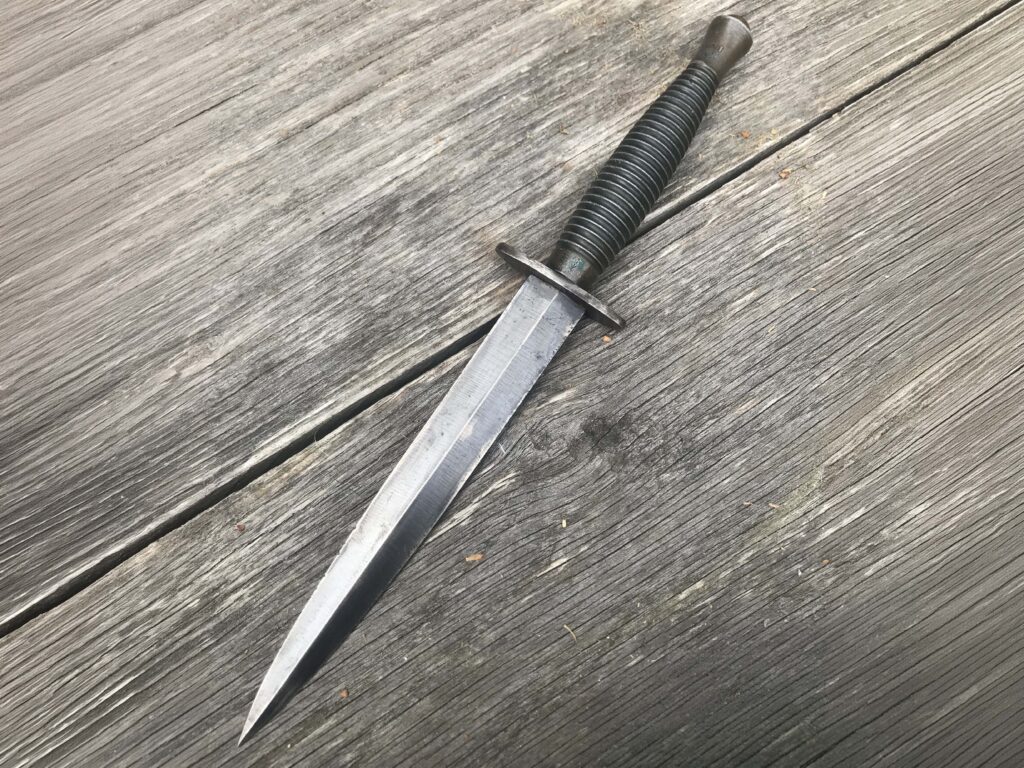
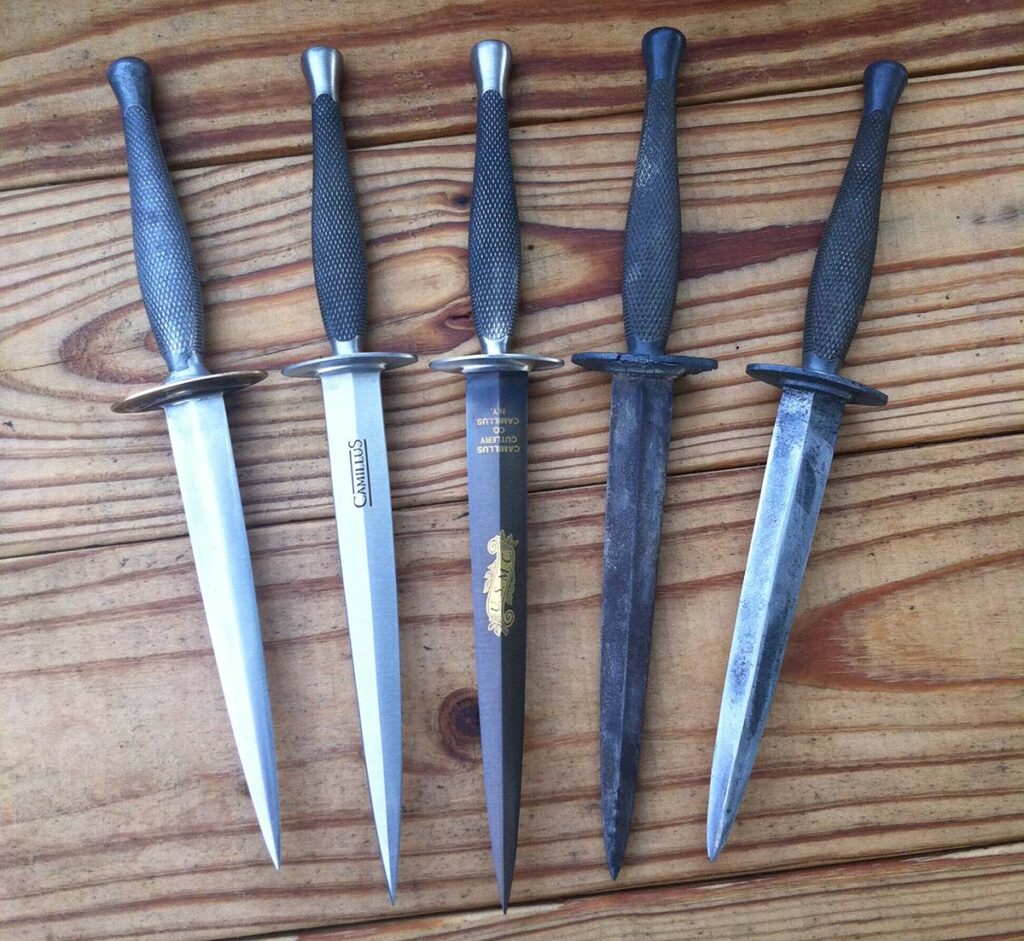
A great many modern military daggers trace their roots back to the legendary English Fairbairn-Sykes dagger. The one pictured is a third-pattern variant with a ring grip. (Les George image)

Industry veteran Bill Harsey also tells a story of combat survival with the Gerber Mk II in Vietnam. “I heard from a Medal of Honor recipient over dinner that his team was overrun by enemy combatants. In close-quarter combat, he drew his knife and stuck it in an enemy soldier. The knife stuck. Even with both hands he couldn’t withdraw it. I have no idea why the knife stuck and he didn’t offer any thoughts. But just to be careful, we have never made a wasp-waisted blade.”

Fairbairn-Sykes And Beyond

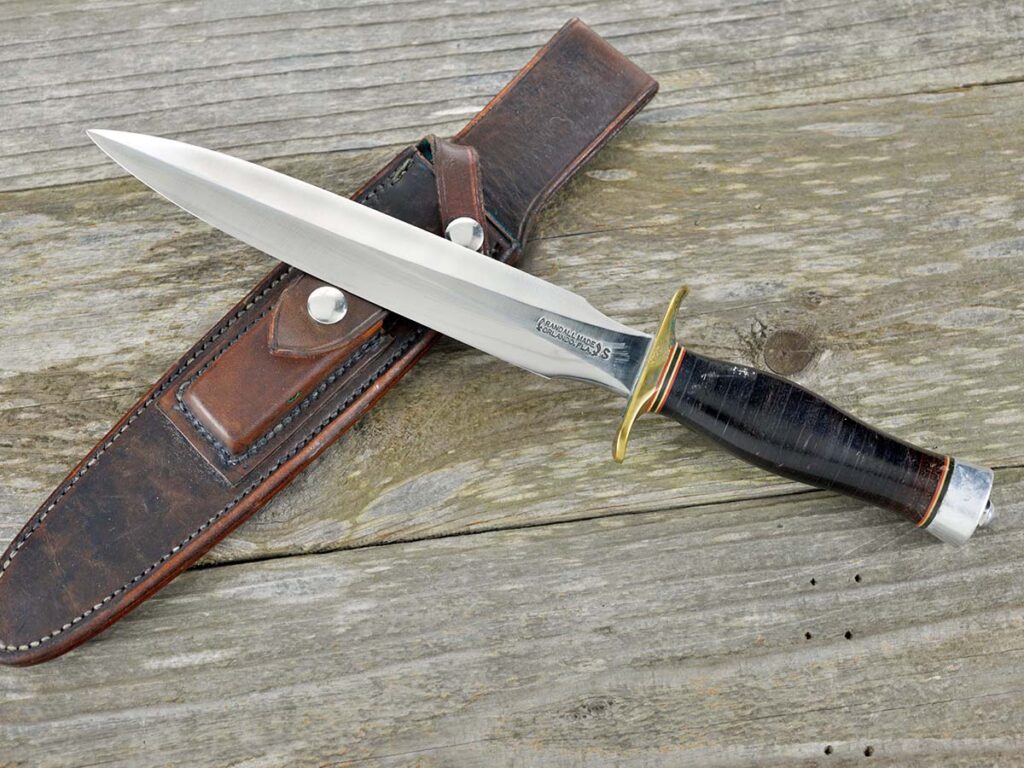
The Randall Knives Model 2 Fighting Stiletto bears the name of one of the most famous knifemakers in history and was developed as a robust alternative to the legendary Fairbairn-Sykes dagger. Randall has gone to war with several memorable designs, and according to Breed, the Model 2 is one of the best remembered.

“The blade is a little wider than the well-known Fairbairn-Sykes dagger,” said Kim. “The Randall was more handle-heavy, with only about a 5-inch blade, as I remember. It feels good in the hand. The guard is not sharp on the fingers, which was a challenge with some of the others. Any Randall daggers are collectible, just like Randalls in general. They didn’t make many of them. The Model 2, to me, is a cross between the Fairbairn-Sykes and the V-42 with a leather stack handle.”

The Randall Knives Model 2 bears the name of one of the most famous knifemakers in history—Bo Randall—and was developed as a robust alternative to the legendary Fairbairn-Sykes dagger. (Les George image)

The Marine Raider Stiletto remains a classic weapon of the World War II era, and it is said to have been the first Marine knife in the Corps’ history designed by a Marine, designed by Lieutenant Colonel Clifford H. Shuey. The story goes that this dagger was developed because the elite Raiders specifically requested a knife for close fighting.

Les offered some observations concerning the Marine Raider stiletto’s proper mission. “When the Marines were issued the Raider Stiletto in World War II, they had been specifically told not to pry with them or throw them,” he said. “So, obviously, they threw them at the first tree they could find and broke the tips off many of those knives.

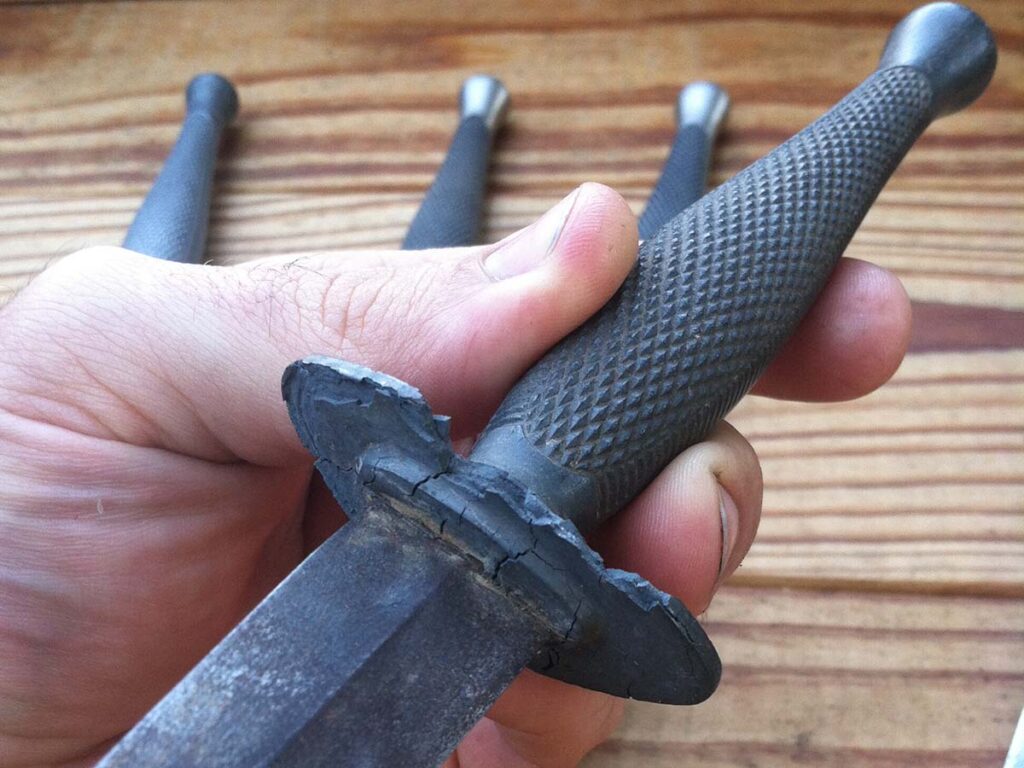
“I think the Marine Raider Stiletto has the best handle design of all the many knives derived from the Fairbairn-Sykes daggers,” George continued. “It’s not just round. It has features and a shape allowing the blade to be indexed by feel. But the blade is very thin, the tip was fragile and the metal that they cast the handles out of reacts with air. They are all disintegrating. Eventually, we will lose them all.”

Knifemaker and military dagger aficionado Les George is a fan of the Marine Raider stiletto, seen by his collection of the dagger—new and old. (Les George image)

The handle of the Camillus-made Marine Raider Stiletto was fashioned with a die-cast zinc alloy, while the 7- to 7 ½-inch blade was made of blued or bright steel. The overall feel of the stiletto was hilt-heavy for optimal balance.

“The Marine Raider Stiletto has probably the smallest group of collectors since it primarily appeals to Marines,” commented George. “The rest can be categorized in different ways and have broader appeal. These knives and their more modern counterparts may not find their way to the battlefield as a matter of course, but the history they represent is invaluable.”

Knuckled Under

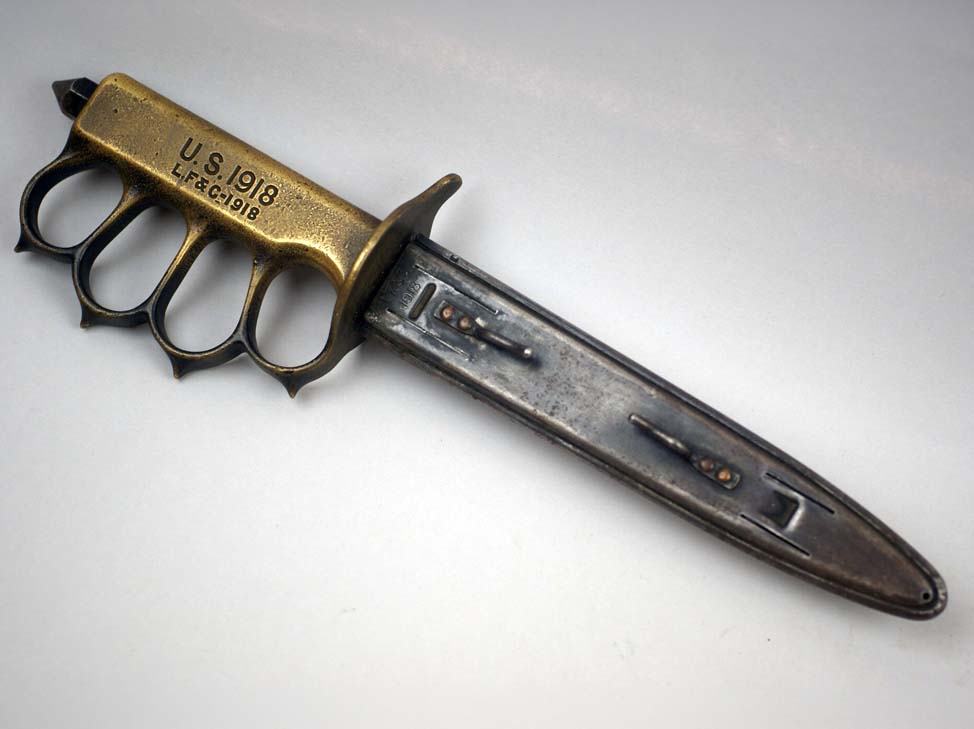
Les includes the iconic M1918 trench knife among those favored few military daggers carried in wartime by American soldiers. Its design was based on the French M1916 Avenger, and the military held field trials after initial 1917 and early 1918 variants were found inadequate. The M1918 was first made by Landers, Frary & Clark, a housewares and hardware company, production was later increased with Oneida, Henry Disston & Sons and the French manufacturer Au Lion.

George considers the knife's handle the best designed of all the Fairbairn-Sykes derivatives. Unfortunately, this is also the dagger’s weak point as the metal used for the handle reacts with the air and disintegrates. (Les George image)
George considers the knife’s handle the best designed of all the Fairbairn-Sykes derivatives. Unfortunately, this is also the dagger’s weak point as the metal used for the handle reacts with the air and disintegrates. (Les George image)

“The LF&C M1918 trench knife did not see action in World War I,” George explains. “It was made for that war, but it ended before the knives made it to Europe. A lot of them were melted down to reuse the handle material. When the Japanese attacked Pearl Harbor, they were the only knives in the system available to be issued to Marines … The M1918 saw use in World War II, Korea and Vietnam. I’m not aware of any combat use of the knife since then, but it is possible.”

The M1918 is distinctive with its integrated cast brass handle and brass knuckle grip designed for close combat, along with small spikes on the finger bows and a skull crusher pommel. The medium carbon steel blade has been criticized at times for being brittle, but nevertheless the knife is recognized as formidable in a hand-to-hand brawl.

“The M1918 was designed to be an effective tool for close fighting,” observed Breed. “With a positive grip and the brass knuckle guard, you didn’t have to stab, or you could hit your opponent with the skull crusher. There were dozens of confirmed kills with this dagger. It was not recommended to dig with them because they were prone to breakage or ‘bendage.’ You could drive that big brass handle into the dirt, but that half shaft that came down from the blade was short on steel and weakened the knife around the tang.”
The eye appeal of the M1918 makes the dagger collectible. “It’s pretty popular and one of the iconic knives of its type,” Kim concluded.

Many think of the M1918 as the quintessential World War I trench knife, though the variant didn't see action in that conflict, adopted too late. Based on the French M1916 Avenger, it was meant to replace the 1917 and early 1918 variants, which were found inadequate. (Les George image)
Many think of the M1918 as the quintessential World War I trench knife, though the variant didn’t see action in that conflict, adopted too late. Based on the French M1916 Avenger, it was meant to replace the 1917 and early 1918 variants, which were found inadequate. (Les George image)

Representative of the fighting men who carried them into harm’s way, these U.S. military daggers of the 20th century continue to fascinate with their double-edge blade, balanced feel and handle characteristics. Their place in history is secure, while collectors and knife industry veterans are doing their best to preserve and retell the stories that surround them.

More On Military Knives:

Advertisement

Must Read Articles

Read this before you make a knife

Knifemaking 101 – Read This Before You Make a Knife

  by Wayne Goddard My experience has taught me that there's nothing like digging in and getting started. I've often said the hardest part of the...
how to forge damascus steel

How to Forge Damascus

Advertisement
Advertisement